The AI Glow-Up of Emerging Markets

As we move through 2026, the convergence of breakneck tech innovation and attractive relative valuations make EM a compelling chapter for investors.
Key takeaways for your portfolio:
- The tech takeover. EM has pivoted from a "commodities" play to a "chips and software" play. Technology and artificial intelligence (AI) sectors dominate the performance of some of the largest EM countries, serving as a far more influential force than energy or materials.
- Deep valuation discounts. EM stocks are trading at compelling discounts compared to U.S. giants, based on price-to-earnings (P/E) ratios for the MSCI Emerging Markets Index versus the S&P 500® Index.1
- The involution risk. Watch out for "involution"—a term for the profit-killing price wars seen in some hyper-competitive markets in China. If AI companies can't turn innovation into actual earnings, their attractive valuations may not matter.
- Keep it balanced. EM now mimics the U.S. tech sector, so it may move in lockstep with some of your larger existing equity holdings. EM is a powerful potential growth engine but might best serve as a "satellite" allocation due to inevitable volatility.
- Currency considerations. Any further softening of the dollar would act as an automatic performance "bonus" for U.S.-based investors holding unhedged international stocks, although dollar strength would have the opposite effect.
Looking for an emerging markets stock fund?
Explore EM funds at Schwab
The "Great Evolution"—From barrels to bytes
To understand why your EM holdings are acting so differently today, it's important to understand their DNA. For decades, these markets were seen as a commodities play—when oil and gold went up, EM usually followed. But a massive structural shift has occurred, moving the index away from the physical world and into the digital one, as illustrated by the following chart.
Emerging markets have become increasingly tech-focused
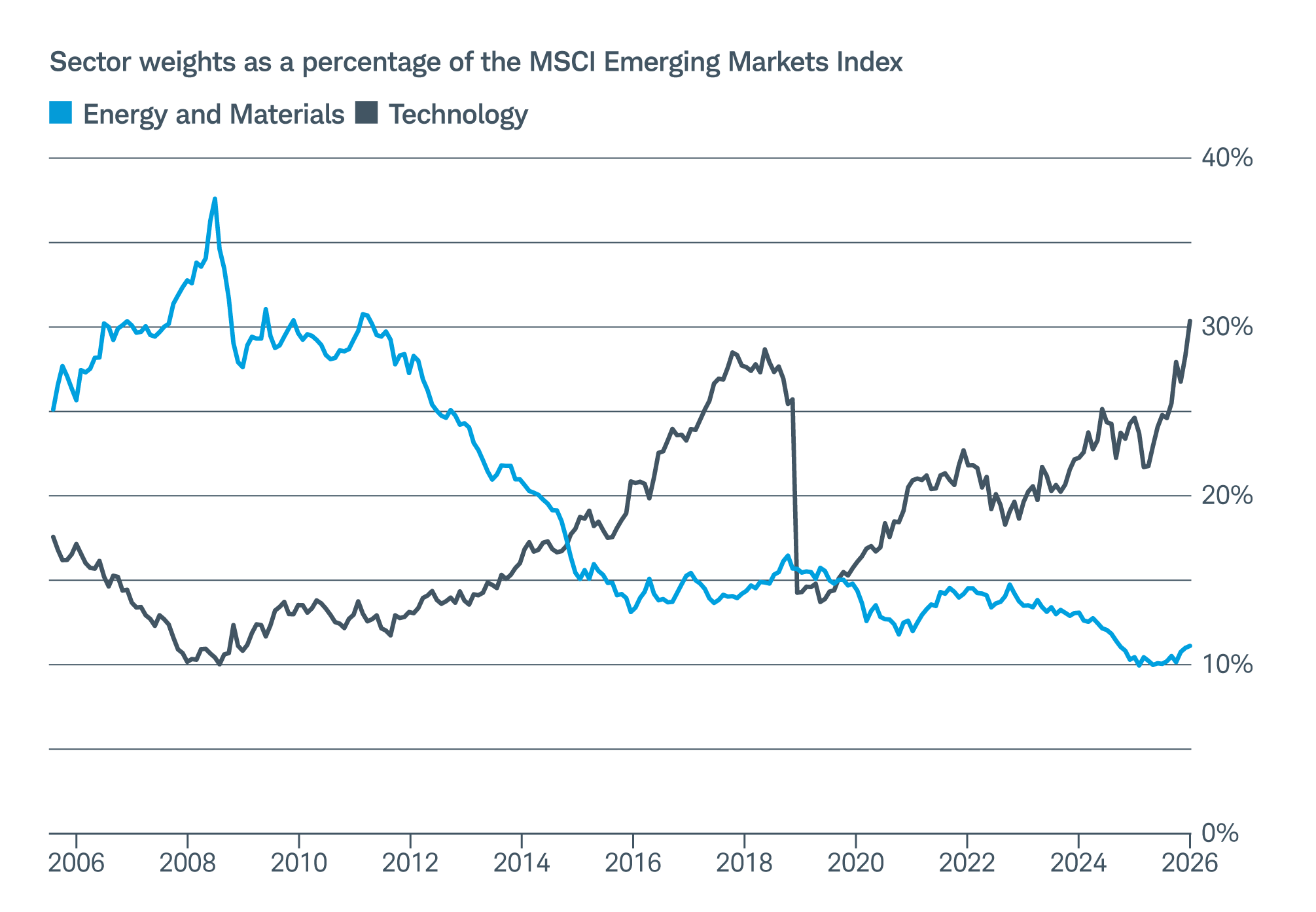
Sources: Schwab Center for Financial Research; MSCI. Data as of 01/06/26.
Sectors are based on the Global Industry Classification Standard (GICS®), an industry analysis framework developed by MSCI and S&P Dow Jones Indices to provide investors with consistent industry definitions. Past performance is no guarantee of future results. Indexes are unmanaged, do not incur management fees, costs, and expenses, and cannot be invested in directly. For more information on indexes, please see https://www.schwab.com/resource/index-and-investment-term-definitions.
As this chart reveals, the "old" emerging markets story of energy and raw materials is fast becoming an outdated classic. When you invest in EM strategies today, you're heavily weighted toward four powerhouse countries2:
- China: Continues to lead EM tech innovation with major investments in AI, cloud computing, and electric vehicles. Regulatory scrutiny persists, but the country's scale and ambition keep it at the forefront of global tech.
- Taiwan: A global powerhouse in semiconductor manufacturing, supplying chips for everything from smartphones to AI servers. Its strategic importance is growing amid rising demand for advanced hardware.
- South Korea: With some of its biggest conglomerates diving into new tech verticals, South Korea is cementing its status as a country on the move. Two of its memory-chip makers account for most of this country's returns so far in 2026.
- India: A major driver of emerging markets, but it's missing the AI wave lifting China, Taiwan, and South Korea. Paradoxically, widespread AI adoption may actually stall India's vital services sector, potentially dragging down its overall economic growth.
AI catalyst—Opportunities and obstacles
The recent buzz isn't just vaporware; it's showing up on balance sheets. The release of elite AI models in early 2025 proved that EM firms could potentially achieve technological milestones with a fraction of the capital used by U.S. competitors. This efficiency of innovation has led to a flurry of IPOs and earnings estimates that have surged.
However, the road is paved with risks. In some regions, government-led AI priorities come with strings—specifically, data limits and potential intellectual property friction. Moreover, export controls on cutting-edge chips are still a persistent headwind. As these examples show, it's important for investors to remember that the impact of AI shouldn't be quickly simplified across markets. Ultimately, material uncertainty exists over which companies will cause disruption and benefit, and which will be disrupted.
Better value, higher stakes
The financial logic for EM now is simple: value. Using the S&P 500 Index and MSCI Emerging Markets Index as proxies, investors are currently paying roughly $13.70 for every $1 of earnings for EM stocks, only slightly above the 10-year average. Meanwhile, in the U.S., that same dollar of profit costs $22.10. Moreover, while the S&P 500 is arguably priced for perfection, EM stocks continue to offer a potential "catch-up" opportunity if earnings targets are met or exceeded.3
Action plan for your portfolio—Your tactical next steps
If you're looking to position your portfolio for this tech-driven EM cycle, here's a playbook to carefully consider or explore with your financial advisor:
- Audit your tech correlation. Review your current holdings. If you're already heavy in U.S. semiconductors or AI software, realize that adding EM might increase your concentration risks rather than lowering them.
- Diversify across the big four. Don't bet on just one country. A balanced allocation across China, Taiwan, South Korea, and India would potentially give you exposure to a diversified range of emerging markets as the influence of AI continues to evolve.
- Prioritize management quality. In markets where transparency can vary, consider focusing on firms with strong track records, clear governance, and transparent reporting.
- Size for survival. EM stocks can be volatile. Only one year of the past 25 saw EM stocks drop less than 10%, so treating your allocation as a core pillar could lead to sleepless nights. Given its high-growth, highly volatile nature, an EM allocation in the 5% to 10% range might be enough to provide some extra "juice" to your portfolio without sinking it if there's a market correction.4
1 Schwab Center for Financial Research, "Emerging Markets: AI Opportunity and AI Risk," published 01/12/26; accessed 01/27/26: https://www.schwab.com/learn/story/emerging-markets-ai-opportunity-and-ai-risk.
2 Ibid.
3 Ibid.
4 Ibid.