The Cash Trap: Liquidity and Your Financial Plan

For most households, keeping three to six months' worth of expenses in a highly liquid emergency fund is crucial. But for those with large monthly expenses, that can mean sidelining excessive reserves of cash.
At the same time, many affluent investors have significant portions of their wealth tied up in concentrated equity positions or privately held businesses that can't be easily liquidated, limiting their ability to quickly convert assets into cash.
"Wealth on paper doesn't always translate to ready liquidity," says Kasey McCurdy, CFA®, chief portfolio strategist for Schwab Wealth Advisory™. "The challenge is to maintain your access to funds without undercutting potential returns or otherwise compromising your valuable illiquid assets."
Here's how to manage your liquidity needs without necessarily turning to cash.
A deeper dive
On the surface, sitting on a comfortable cushion of cash feels like one of the safest moves you can make; no matter what happens in the market, that money is secure. However, investors whose cash reserves far exceed the typical three-to-six-month threshold expose themselves to potentially corrosive risks, including:
- Reinvestment risk: Cash equivalents like U.S. Treasury bills and certificates of deposit (CDs) must be rolled over when they mature, and if interest rates have fallen in the interim, the lower rate of return on reinvestment can prove insufficient.
- Inflation risk: Current yields on cash and cash equivalents of about 3% look adequate now, but rising prices could narrow the gap between cash yields and inflation.
- Opportunity cost: Over the past 20 years, a moderate-risk portfolio generated an average annual return of 7.73%, whereas cash in a standard bank account returned just 1%. "That diminished return from not being invested in markets is perhaps the biggest risk—and it's the part most people miss," Kasey says.
"Stepping back, the daily news cycle tends to emphasize the market's inevitable ups and downs, which can make cash feel more rational than it actually is," he adds.
The investing difference
Over the past 20 years, $200,000 invested in a moderate-risk portfolio would have grown to nearly $797,000, whereas that same amount held in a standard bank deposit account would be worth just $244,000.
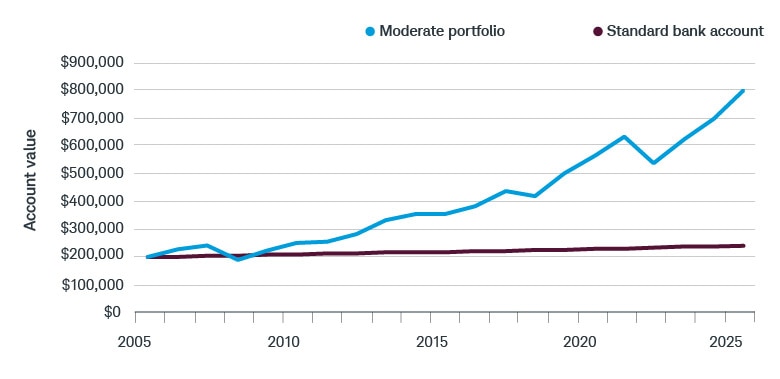
Source: Schwab Center for Financial Research with data from Morningstar.
Data from 12/31/2005 to 12/31/2025. The indexes used are: S&P 500® (large-cap equity), Russell 2000® (small-cap equity), MSCI EAFE® Net of Taxes (international equity), Bloomberg U.S. Aggregate Bond Index (fixed income), and FTSE 3-Month U.S. Treasury Bill Index (cash equivalents). The moderate-risk portfolio is 35% large-cap equity, 10% small-cap equity, 15% international equity, 35% fixed income, and 5% cash, using the indexes noted. Indexes are unmanaged, do not incur management fees, costs, and expenses, and cannot be invested in directly. For more information on indexes, please see schwab.com/indexdefinitions. The standard bank account assumes a 1% interest rate. Fees and expenses would lower returns. This hypothetical example is only for illustrative purposes. Investing involves risk, including loss of principal. Past performance is no guarantee of future results.
A two-pronged approach
Although the three-to-six-month benchmark remains a reasonable starting point—even for the wealthy—not all liquidity needs demand immediate access to cash.
"Instead of simply holding a specific dollar figure in cash, consider the types of liquidity events you could face and how best to meet them," Kasey says. "That generally means having a plan that accounts for both unexpected and expected expenses."
- Unexpected expenses: These true financial emergencies, while rare for affluent households, should still figure in your plan. "Sudden long-term care expenses, a precipitous decline in a concentrated asset position, and even legal liabilities can happen to the best of us," Kasey says. "Having a cash cushion you can tap immediately with minimal tax consequences—including cash equivalents such as U.S. Treasury bills, money market funds, and CDs—is what you're looking for."
- Expected expenses: Liquidity needs you can anticipate—such as a child's tuition, a home purchase or renovation, or seed money for a new business venture—can be invested more strategically, with an eye toward higher yields without sacrificing principal preservation or easy access to funds. For example, you could use taxable brokerage accounts with a mix of liquid and conservative investments—including intermediate-term bond funds and bond ladders—to cover anticipated but irregular expenses.
If a large equity position or private business is serving as your long-term wealth engine, this two-pronged approach becomes especially important. That's because drawing on a concentrated position prematurely, or under duress, can be detrimental to the underlying asset, which is precisely the outcome that a plan is designed to prevent.
"Wealth gives clients more options but doesn't eliminate the need for a liquidity plan," Kasey says. "The goal is to create flexibility before the cash is needed, so a client is not forced to sell an important asset at an inopportune time or in a tax-inefficient way."
Flexible liquidity
There are several options that can provide liquidity while also preserving your longer-term positions. Your choice depends on your comfort with borrowing and how you plan to use the money:
- A securities-based line of credit (SBLOC) allows investors to borrow against the value of their nonretirement investment portfolio, usually at a variable interest rate. The position stays intact without triggering a taxable event, and the investor gains access to funds that can be deployed for emergencies, large purchases, and other needs. Keep in mind that an SBLOC cannot be used to invest in securities. "An SBLOC can provide on-demand capital for both unexpected and planned expenses without disrupting your long-term investment strategy," Kasey says.
Learn about Schwab Bank's Pledged Asset Line®.
- A home equity line of credit (HELOC) works in a similar way to an SBLOC, allowing homeowners to borrow against the equity in their primary or secondary residence at rates typically lower than those offered by credit cards or personal loans. "HELOCs are often the best choice for home-related expenses, whether expected or not, because of the potential tax deductibility of the interest when used for substantial home improvements," Kasey says.
Learn about Schwab Bank's home equity line of credit.
- A bond or CD ladder involves purchasing multiple bonds or CDs with different maturity dates. "Rather than waiting for an emergency and then deciding what to sell, you can structure your portfolio so maturities line up with known expenditures like tuition or tax payments, helping to ensure the cash is available exactly when you need it," Kasey notes.
Learn how Wasmer Schroeder™ Strategies can build and professionally manage bond ladders to achieve a wide range of portfolio objectives.
- Strategic sales from a taxable portfolio can raise cash in a way that not only limits the damage to your overall portfolio—by, say, selling positions with the lowest tax impact first—but also potentially improves it by harvesting losses or trimming overweight exposures to rebalance back to your target allocation. "This approach is ideal for upcoming expenses, as it allows you to strategically time sales to maximize tax efficiency and maintain your target risk profile," Kasey says.
Learn more about managing capital gains.
When creating a liquidity plan, investors should be mindful that borrowing-based solutions come with tradeoffs. HELOCs and SBLOCs involve costs and conditions—including variable interest rates, collateral requirements, and terms prohibiting the borrower from taking specific actions—that could inhibit repayment of the debt or lower the investment's value. Working with an experienced wealth strategist can help ensure you have a cost-conscious, flexible, and tax-efficient plan.
Put liquidity into your plan
It's important for investors to have a robust financial plan that accounts for a range of liquidity needs. For investors with large equity positions, that means having a tax-aware strategy for managing concentration risk. For business owners, that means factoring unexpected costs into their overall business and succession planning.
Yet everyone should revisit their cash needs regularly—and not just defensively in response to market moves but also proactively due to life events. A layoff, an inheritance, a marriage, a divorce, or a business transaction can all shift your financial picture.
Kasey recommends at least an annual review for self-directed investors, and quarterly reviews for those working with an advisor. "Ideally, you should be neither cash starved nor cash heavy," he says. "Strive to have enough liquidity to handle life's unexpected turns without sacrificing the potential long-term growth that wealth makes possible."
Discover more from Onward

Keep reading the latest issue online or view the print edition.