Corporates or Treasuries? Shrinking Credit Spreads

For income-focused investors, the current bond market is a bit of a mystery.
While yields on investment-grade corporate bonds are relatively attractive, they aren't much greater than lower-risk Treasury bonds, which suggests investors aren't being adequately compensated for the extra risk. Indeed, according to Bloomberg,1 the spread between corporates and Treasuries hasn't been this tight since 1998.
A shrinking premium
The credit spread on U.S. investment-grade corporate bonds has compressed to its tightest level in nearly 30 years.
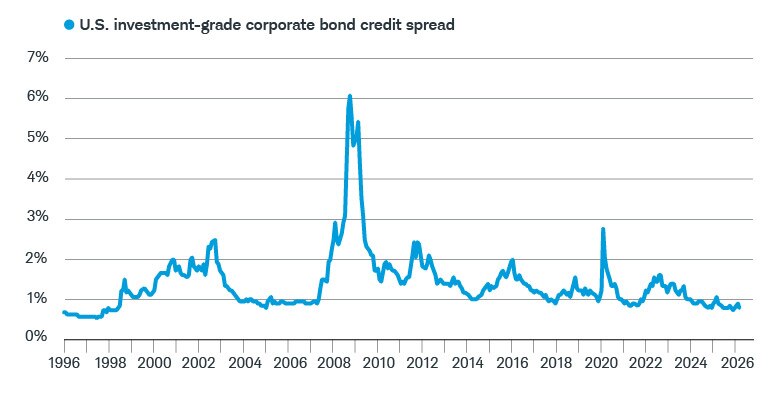
Source: Bloomberg U.S. Aggregate Corporate Average Option-Adjusted Spread (LUACOAS) Index.
Data from 01/31/1996 through 06/30/2026.
"While a 5% yield is attractive, if Treasuries are yielding 4.25%, you have to decide whether the extra three-quarters of a percentage point is worth the potential risk of default," says Collin Martin, CFA®, head of fixed income research and strategy at the Schwab Center for Financial Research. "To me, a spread of at least 100 basis points, or 1 percentage point, feels more appropriate now."
That doesn't mean investment-grade corporate bonds aren't worth considering. "Narrowing spreads can often be a sign of investor confidence in corporate bonds," Collin notes, "and most corporations are in pretty good shape, with strong balance sheets and enough cash flow to withstand an economic slowdown." In the fourth quarter of 2025, for example, corporate profits rose a healthy 5.7% over the previous quarter.2
Plus, wider spreads might not be far off as "hyperscalers" like Amazon and Meta look to issue hundreds of billions of dollars in bonds to fund their artificial intelligence (AI) infrastructure. "Given the scale of their ambitions, companies may need to offer higher yields and lower prices to attract enough buyers," Collin says.
That said, investors should do their homework before buying any bond. "If one bond's yield is particularly attractive relative to its peers, that's reason to dig deeper," Collin says. For example, if most AA-rated corporate bonds are offering a yield near 5% but one is paying 6%, it might signal that investors expect a downgrade.
"More often than not, an above-average yield means the bond is riskier than the credit rating suggests," he says. "There's no free lunch."
Research investment-grade corporate bonds by credit rating, price, yield, and more.
1Rainier Harris and Finbarr Flynn, "AI Debt Binge Is Set to Test Credit's 1990s-Like Euphoria," bloomberg.com, 01/23/2026.
2"United States Corporate Profits," tradingeconomics.com, as of 04/09/2026.
Discover more from Onward

Keep reading the latest issue online or view the print edition.