Factor-Based Investing: Basics, Strategies, Risks
Key takeaways
- Factor-based investing targets drivers of risk and return to help investors align their portfolios with specific goals.
- Macroeconomic factors can help investors assess exposure to economic growth, interest rates, and inflation.
- Style factors focus on characteristics such as value, momentum, quality, volatility, or size that can help investors tilt a portfolio toward specific goals or market exposures.
- Investors can apply factor strategies by screening for individual stocks or by investing in active or passive funds, including smart-beta ETFs.
The popularity of passive index investing has surged over the past two decades. But any time markets trade near their record highs or indexes become overly concentrated, some investors begin to look for ways to manage risk and diversify their holdings.
Factor-based investing often garners attention in these environments because it offers a way for investors to be more selective by targeting stocks with certain characteristics. That doesn't necessarily mean giving up the tried-and-true passive approach. Investors can use factors to select individual stocks or opt for rules-based funds that track securities with specific traits. However, it's critical to understand how factor-based investing works—and the risks involved—before getting started.
What is factor-based investing?
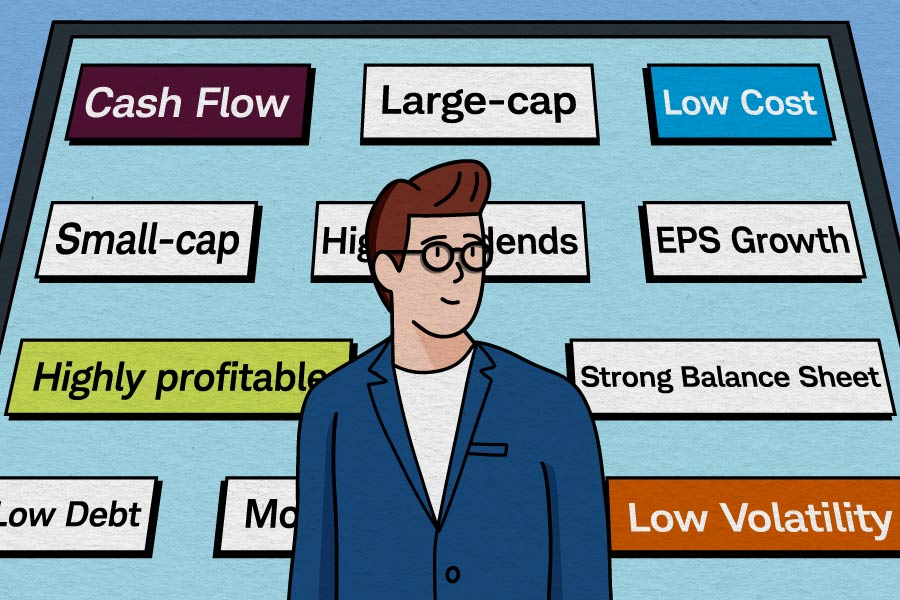
Factor-based investing involves targeting specific drivers of risk and return, called factors. It's an approach that can tilt a portfolio toward a factor like value, momentum, or quality. This can help investors focus on specific goals, such as generating income, lowering volatility, or enhancing diversification.
Types of factors
There are two main types of factors used in factor-based investing: macroeconomic and style.
Macroeconomic factors are broad economic forces that drive risks and returns across all asset classes. Common macroeconomic factors include economic growth, interest rates, and inflation.
Different investments have different levels of exposure to these factors. Economic growth, for example, is an important driver of corporate earnings and stock returns, while interest rate changes have a more direct impact on bond returns. Investors can use these factors to bias their portfolios toward—or away from—specific asset classes, sectors, or regions based on their goals or changes in economic and market conditions.
Style factors are characteristics of individual securities that drive risks and returns within asset classes. Like macroeconomic factors, they can be used to construct a portfolio that focuses on achieving a certain goal, like managing risk or diversifying. The table below details five main style factors.
|
Style factor |
What it does |
Common metrics used |
|---|---|---|
|
Value |
Tracks stocks that appear inexpensive relative to their fundamentals |
Price-to-earnings ratio, price-to-book ratio, EV/EBITDA |
|
Momentum |
Focuses on stocks with strong recent price performance |
Three- to 12-month trailing returns |
|
Quality |
Prioritizes stocks of companies with solid financial fundamentals |
Return on equity, return on invested capital, profit margins, debt-to-equity ratio |
|
Volatility |
Emphasizes stocks with low volatility compared to the broader market |
Standard deviation of returns, beta coefficient |
|
Size |
Targets stocks with smaller market capitalizations |
Market capitalization, enterprise value |
Factor-based investing strategies
There are two main ways investors implement factor-based investing: selecting individual stocks based on factor-specific characteristics or using actively or passively managed funds.
Those who would rather not pick individual stocks often invest in exchange-traded funds (ETFs) that tilt their portfolios toward certain factors.
Passive factor-based ETFs—sometimes called smart-beta ETFs—typically track rules-based indexes built around a particular factor, like value or quality. Active factor-based ETFs use fundamental research, quantitative models, or other methods to select stocks based on specific criteria, such as earnings growth, profit margins, or debt levels. Some active factor-based ETFs even rotate from one factor to another, depending on economic and market conditions.
Want to learn more about passive factor-based investing? Check out Schwab's smart-beta ETFs page.
Investors who take a do-it-yourself approach to factor-based investing typically use stock screening tools to find equities with specific factor characteristics.
For example, an investor targeting the quality factor might screen for companies with high returns on equity (ROE), strong free cash flow (FCF), or low debt-to-equity (D/E) ratios. An investor pursuing the value factor might focus on valuation metrics like price-to-earnings (P/E), price-to-book (P/B), or price-to-cash-flow (P/CF) ratios. And an investor eyeing the momentum factor might look for stocks that have outperformed a market benchmark like the S&P 500® Index (SPX).
Factor-based investing in the Temperamental Era
While the two decades leading up to the pandemic were characterized by low inflation, low rates, and suppressed volatility, that's changed in recent years. Liz Ann Sonders, chief investment strategist at the Schwab Center for Financial Research, believes markets are now in another "Temperamental Era" similar to what occurred in the 1960s through the 1990s.
In this environment, investors may be forced to contend with frequent supply shocks, geopolitical instability, index concentration, and a less supportive Federal Reserve—not just now but for years to come. Finding stocks with characteristics that may perform well in this more volatile economic regime could become increasingly important, potentially making factor-based investing more appealing.
"Our conviction has been (and still is) that a new version of the Temperamental Era is not a bad one that lacks opportunities for investors—it's just a different environment than what's faced investors over the past quarter century," Sonders wrote in a recent article. "We continue to believe factor- and characteristic-based investing may suit investors well in a world of greater return dispersion."
Risks of factor-based investing
Like any investment strategy, factor-based investing comes with risks and trade-offs that investors need to consider:
- Higher costs or fees. Factor-based ETFs typically have higher expense ratios than traditional broad-market index funds. Investors who build their own factor-based portfolios may also face higher transaction costs from more frequent trading or rebalancing.
- Cyclicality. Factors can underperform for extended periods in certain economic regimes. This can make it tempting for investors to abandon a strategy and lock in losses at the wrong time. Some investors choose to combine multiple factors to smooth out the cyclical performance of any one single factor.
- Concentration. Targeting a particular factor can lead a portfolio to become overly concentrated in certain sectors, industries, or asset classes. It can also make a portfolio more volatile than the broader market.
- Crowding. Popular factor-based strategies can pull large amounts of money into stocks with similar characteristics, potentially pushing up their valuations. This could reduce the factor's future return potential.
- Inconsistent definitions. There's no single way for funds to target factors like value or quality. Funds targeting the same factor can end up with very different portfolios, leading some to outperform others.
Bottom line: A flexible investment option
Factor-based investing has gained traction in recent years due to its ability to help investors focus on their unique goals. It's a strategy that can cater to anyone, from a retiree looking to build a passive income stream to a younger investor who wants a growth-focused portfolio. However, it's important that investors understand the factors they're targeting and weigh the risks involved before implementing a factor-based investing strategy.