How to Donate Your RMD to Charity Using a QCD
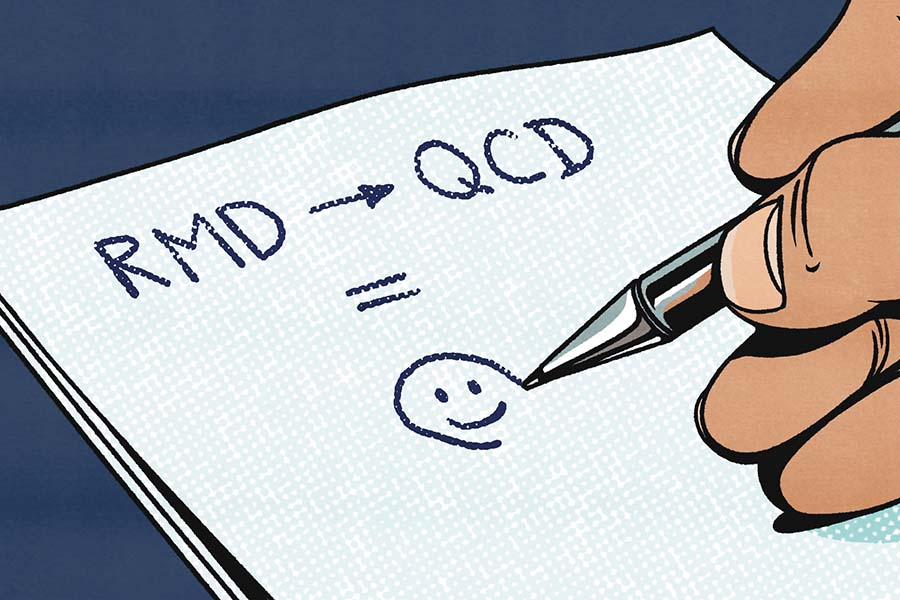
As December 31 approaches, some charitably minded retirees who haven't taken their required minimum distributions (RMDs) for the year can consider achieving two goals at once—making a qualified charitable distribution (QCD) directly from an IRA to an eligible charity while also satisfying all or a portion of the RMDs that kick in at age 73 or 75, depending on birth year.
Plus, because QCDs are excluded from taxable income, they can help retirees lower their adjusted gross income (AGI), which in turn may reduce Medicare premiums and the taxable portion of Social Security benefits.
"If you already have charitable intentions and don't need the money to live on, a QCD can be an extremely efficient way to give," says Hayden Adams, CPA, CFP®, director of tax planning and wealth management research at the Schwab Center for Financial Research.
To execute a QCD before year-end:
- Confirm eligibility: You must be 70½ or older and initiate the transfer from a tax-deferred IRA, including traditional and inherited IRAs, as well as inactive SEP or SIMPLE accounts. QCDs are not permitted from 401(k)s.
- Fill out a QCD form: This document—provided by your IRA custodian—directs payment of up to $111,000 in 2026 to a qualified 501(c)(3) charity. (QCDs generally cannot be made to donor-advised funds and most private foundations.) You may also make a once-in-a-lifetime donation of up to $55,000 to a charitable gift annuity or charitable remainder trust, which will count toward your annual QCD limit that year.
Download the Schwab QCD form.
- Allow enough time: "Transfers from an IRA to an eligible charity take time, so don't wait until the last minute and risk missing the year-end deadline," Hayden says.
Note that if you've taken your RMD for the year and already donated the funds, you cannot retroactively classify it as a QCD—but you can still deduct your donation if you itemize. Because QCD transfers don't count as taxable income, they aren't tax-deductible.
Also, there may be other options, like donating appreciated assets, that could deliver more tax savings than a QCD.
"QCDs are just one way to manage your charitable and tax goals," Hayden says. "It's best to work with your financial or tax advisor to determine which solutions are the best fit for your situation."
Discover more from Onward
Keep reading the latest issue online or view the print edition.