How to Trade Binary Options at Schwab

Key takeaways
- Binary options are short-term contracts with a fixed, all-or-nothing payout based on whether an underlying security closes above or below a specific strike price.
- Unlike traditional options, binary options do not give traders the right to buy or sell the underlying security.
- They offer less flexibility, but their maximum gain and loss are known before the trade is placed.
- Schwab currently offers only long call and long put XSP binary options with 0DTE and 1DTE expirations.
- Before trading, traders should understand the risks of binary options' short time frames, fixed payouts, and potential volatility.
Binary options are a relatively straightforward way for traders to speculate on short-term market moves. However, their all-or-nothing structure comes with unique risks that traders should understand before placing a trade. Knowing how binary options differ from traditional options can help traders better assess how each option type may—or may not—align with their trading strategies and personal goals.
What is a binary option?
A binary option is a type of derivative contract that offers a fixed, all-or-nothing cash payout based on the outcome of a basic yes-or-no proposition. Typically, that proposition is whether the price of an underlying asset—like a stock or broad market index—will close above or fall below a specified price on a set date.
With binary call options, traders receive a fixed payout if the underlying closes at or above the specified strike price. With binary put options, traders receive a fixed payout only if the underlying closes below the specified strike price.
This structure can make binary options particularly risky. A contract that finishes just on the wrong side of its strike price will expire worthless, while a large move in a trader's favor doesn't increase the fixed payout. That makes accurately predicting whether the underlying asset will finish above or below the strike price especially important.
How binary options differ from traditional options
Binary options share a lot of terminology with traditional options, but the similarities between the two are actually quite limited.
While binary options allow traders to speculate on a simple "yes" or "no" proposition, traditional options offer more flexibility. They can be combined to create various types of complex trading strategies, allowing traders to manage risk, generate income, or potentially profit—even without taking a stance on the direction of the underlying.
Traditional options also give buyers the right, but not the obligation, to buy or sell an underlying security at a set price within a specific time frame. Binary options don't provide that right. Instead, any potential payout is simply settled in cash at expiration.
Moreover, traditional options' value is driven by more than just the price of the underlying. Factors like time to expiration, implied volatility, interest rates, and more all play a role. This makes traditional options' risk and reward profiles far more complex.
The maximum potential gain and loss of a binary option are always known before the trade is placed, but traditional options can have defined or undefined risk depending on the strategy, and their potential payoffs tend to fluctuate continuously.
The table below summarizes the key similarities and differences of binary and traditional options:
| Feature | Binary Options | Traditional Options |
|---|---|---|
| Market view | Directional with a "yes/no" outcome | Varies by strategy; can be directional, neutral, or volatility-focused |
| Payout structure | Fixed, all-or-nothing payout | Varies by strategy; generally, payout fluctuates based on factors like underlying price, implied volatility, time to expiration |
| Maximum gain | Limited to fixed payout minus premium paid | Varies by strategy |
| Maximum loss | Premium paid | Varies by strategy |
| Expiration | Short-term | Short-, medium-, and long-term |
| Settlement style | European style | American or European style |
| Early exercise | Not permitted | Permitted for American-style options |
| Can close out prior to expiration | Yes | Yes |
What to know about binary options at Schwab
Schwab offers Mini-S&P 500 Index (XSP) binary options under the symbol $XSPBX. Only long calls and long puts are available; there are no short binary options. Cboe Global Markets only lists zero days to expiration (0DTE) and one day to expiration (1DTE) binary options at this time.
Importantly, the settlement value (fixed payout) for binary options is $1.00, regardless of the expiration date, strike price, or underlying security. The contract multiplier is 100, meaning the cash payout for a correct "yes" or "no" prediction is $100 ($1.00 x 100) per contract minus the premium paid.
Binary option examples
Let's walk through two examples to illustrate how binary options work. Note that these examples exclude the impact of taxes, commissions, and fees, which could alter the potential net gain or loss for traders.
Scenario 1: A binary call option
Suppose $XSPBX is trading at $775, and a trader buys a 0DTE call at the 780-strike for $0.50.
- If $XSPBX closes at $780, the trader receives the $1.00 fixed payoff. Subtracting the $0.50 premium paid ($1.00 - $0.50) and multiplying by the contract multiplier ($0.50 x 100), the trader's net profit is $50.
- If $XSPBX closes at $800, the trader still receives only the $1.00 fixed payoff, resulting in the same $50 net profit despite the large move above the strike price.
- If $XSPBX closes at $779, the call expires worthless and the trader loses the $0.50 premium paid. Multiplying by the contract multiplier, the trader's net loss is $50 ($0.50 x 100).
- If $XSPBX closes at $750, the call still expires worthless, resulting in the same $50 net loss despite the larger move below the strike price.
Scenario 2: A binary put option
Suppose $XSPBX is trading at $775, and a trader buys a 0DTE put at the 770-strike for $0.50.
- If $XSPBX closes at $769, the trader receives the $1.00 fixed payoff. Subtracting the $0.50 premium paid ($1.00 - $0.50) and multiplying by the contract multiplier ($0.50 x 100), the trader's net profit is $50.
- If $XSPBX closes at $750, the trader still receives only the $1.00 fixed payoff, resulting in the same $50 net profit despite the large move below the strike price.
- If $XSPBX closes at $770, the put expires worthless and the trader loses the $0.50 premium paid. Multiplying by the contract multiplier, the trader's net loss is $50 ($0.50 x 100).
- If $XSPBX closes at $800, the put still expires worthless, resulting in the same $50 net loss despite the larger move above the strike price.
Note: As previously mentioned, call options must close in-the-money (ITM) or at-the-money (ATM) for traders to receive this payout, while put options must close ITM.
To learn more about XSP binary options, visit Cboe Global Market's FAQ page, contact us online, or give us a call at 800-435-4000.
How to trade binary options at Schwab
Binary options trading is available on all Schwab platforms, including thinkorswim®, thinkorswim Web, Schwab.com, and Schwab Mobile.
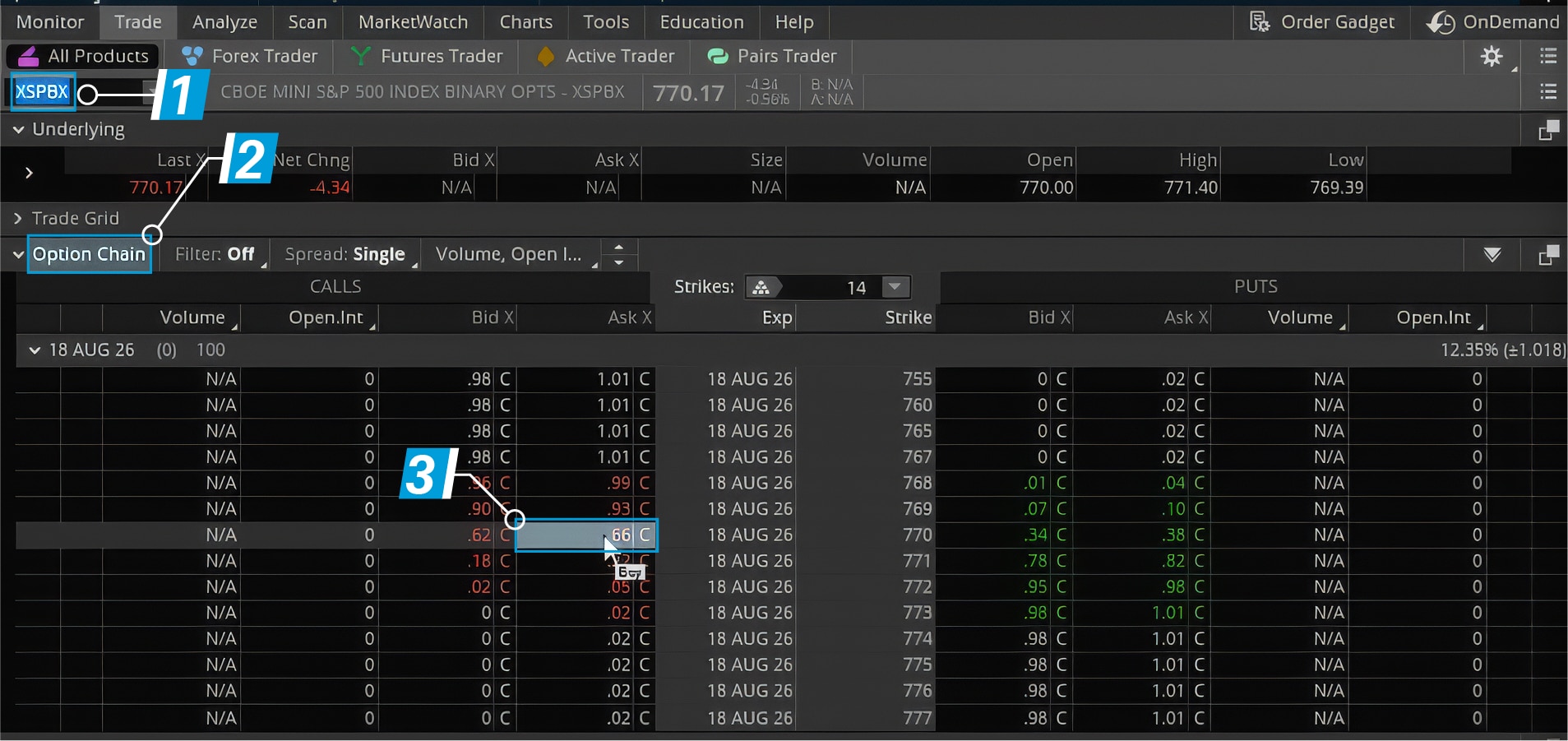
The order process is straightforward and similar to buying a traditional call or put option. Let's walk through how to buy a binary call option in three steps using thinkorswim desktop:
Step 1: Search for $XSPBX (1) in the symbol selector and open the Option Chain (2). Then select the desired option (call or put), strike price, and expiration date (3).
Source: thinkorswim
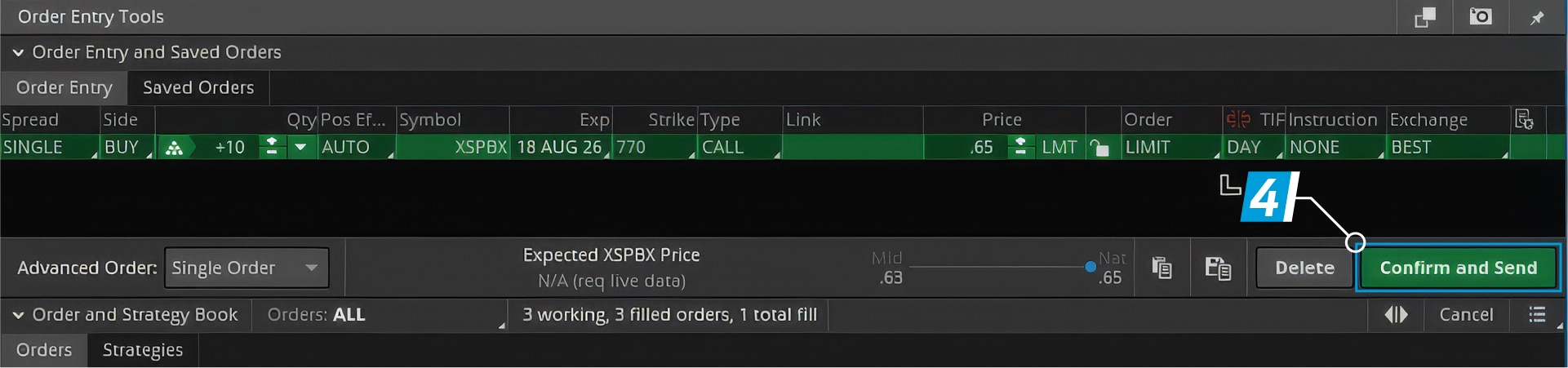
Step 2: Review the order in the Order Entry field to ensure the correct option was selected, then press Confirm and Send (4).
Source: thinkorswim
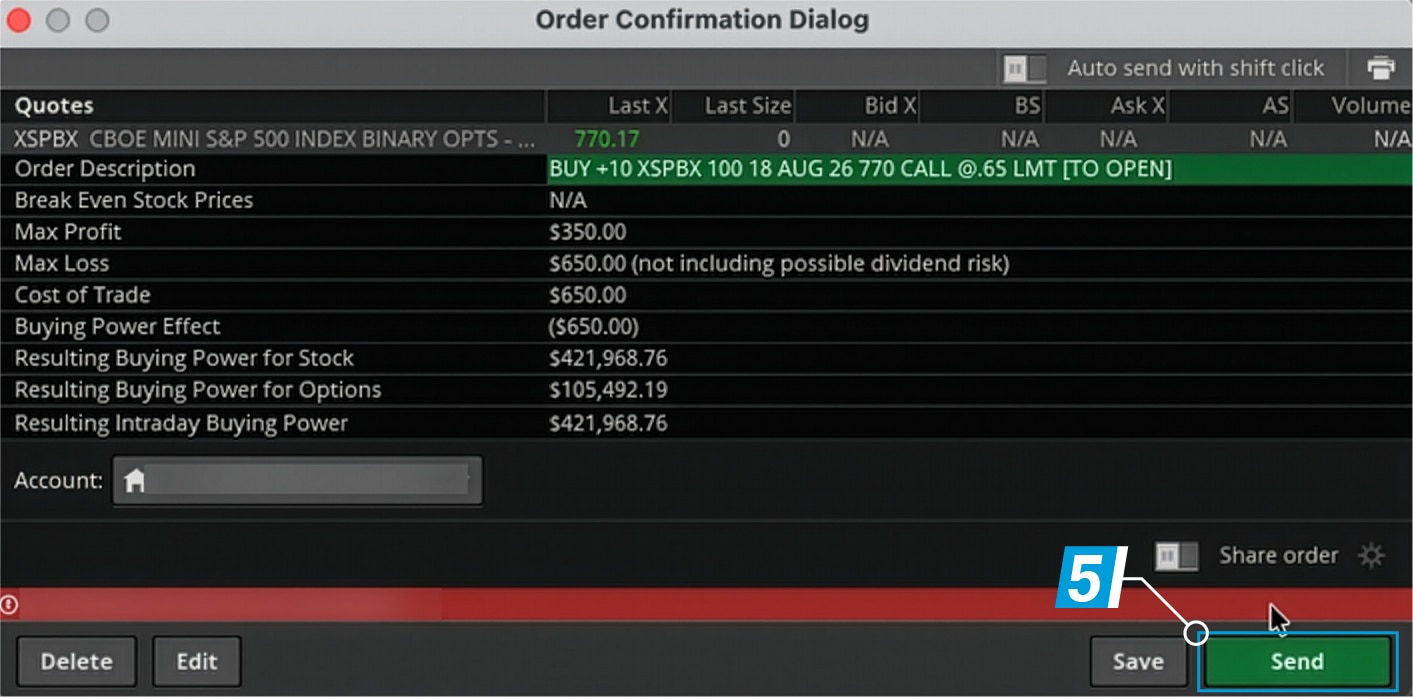
Step 3: The Order Confirmation Dialog box will automatically open. Confirm the order is correct, review key information, such as the maximum profit and maximum loss, then press Send (5).
Source: thinkorswim
Final considerations before trading binary options
Binary options may seem straightforward, but their all-or-nothing structure can create some unusual risks. Here are a few final considerations to keep in mind before trading:
- Expect volatile price movements near expiration. Binary options can be more volatile than traditional options when the current underlying price is at or near the strike price as expiration nears. This is because even a small price move can significantly change the likelihood that a binary option will result in a full payout.
- Short expirations leave little room for error. With only 0DTE and 1DTE expirations available for binary options at this time, traders will have limited time for unfavorable price moves to reverse before expiration. Remember, getting the price direction right may not be enough if the move doesn't happen in time.
- Keep liquidity in mind. Binary options are new and very-short-dated products, so potential liquidity issues are worth considering. While these options can generally be closed before expiration, lower liquidity could widen bid-ask spreads, potentially making it more difficult or expensive to exit a position.
Binary options FAQs
What level of options approval is required to trade binary options?
Clients must have Level 1 options approval before trading binary options.
How are binary option strike prices determined?
Strikes for both 0DTE and 1DTE options are listed based on the closing level of $XSPBX. Cboe Global Markets lists strikes in $1 increments between 80% and 110% of the closing level of $XSPBX. For example, if $XSPBX closes at $1,000, strikes would range between $800 and $1,100 in $1 increments.
Can clients request additional strikes?
Cboe Global Markets determines available strikes. Clients cannot request additional strikes.
Can I see options greeks for binary options on Schwab platforms?
Not at this time.
Can I use the Analyze tab on thinkorswim for binary options?
The Analyze tab will not display the expected profit/loss for binary options at this time.
Can I use margin to trade binary options?
Clients must use their option/non-marginable buying power to purchase binary options.