Lost in the Ether: What Can Drive Ether's Price?

Key takeaways
- Ether is the second-largest cryptocurrency by market capitalization, behind bitcoin.
- Ether has had a high correlation to bitcoin, and moves in bitcoin's price tend to be the primary driver of ether's price. However, as the crypto market matures, ether's fundamental drivers—on-chain application development, lending and tokenization—may have more of an influence on its performance.
- A tactical indicator can be created for ether by dividing its market capitalization by the sum of all fees generated on the Ethereum platform.
- This could be the year that the Ethereum blockchain asserts itself as the leading smart contract platform, overcoming debates regarding its scalability as institutional tokenization accelerates.
For investors interested in knowing more about cryptocurrencies, ether is an important one to learn about.
Ether was a substance at the center of a 19th century scientific theory that proposed there was an invisible, weightless, and frictionless medium filing all space to transmit light waves, and it inspired the name of the Ethereum blockchain. Ether is the native cryptocurrency of the Ethereum blockchain. It was launched in 2015 and has since grown to be the second-largest cryptocurrency by market capitalization as of December 31st 2025, according to CoinMarketCap.com. As investors begin to learn more about cryptocurrencies, ether is an important one to learn about as it serves a different purpose than bitcoin. We previously wrote about what factors can drive bitcoin's price, and below we will identify key factors for ether. We also discuss fundamentals related to valuing ether, upcoming catalysts that could impact key investor debates.
Intro to ether
Ethereum was created by Vitalik Buterin and aimed to improve upon the Bitcoin blockchain by offering a platform that applications could be built on. Within the crypto industry, these applications are referred to as dApps (decentralized applications). We published an industry analysis of the digital asset industry where we broke the industry up into foundational networks, infrastructure and products.
There are three major differences between Ethereum and Bitcoin. First, transactions on Ethereum can be encoded with logic. Contracts built on Ethereum are called smart contracts. They can be programmed with rules that specify what happens when the terms of the contract are fulfilled (usually a specified amount of ether is transferred).
Second, ether is not a disinflationary currency. There is constantly more ether being created, unlike bitcoin. To balance that out, when a transaction is approved on Ethereum, a certain amount of ether is burned (sent to unrecoverable accounts), to limit the dilution of existing ether.
Third, Ethereum uses a proof-of-stake consensus mechanism to secure the blockchain, as opposed to Bitcoin's proof of work. Proof of stake is a process where validators place some of their ether in escrow. They are rewarded with new ether for maintaining the correct historical version of the blockchain when recording new blocks. Escrowed ether is forfeited if validators have inaccurate version of the blockchain. This process helps prevent validators from being bad actors.
Proof of work is an energy-intensive method of maintaining a blockchain where computers race to solve a mathematical equation. The first validator to solve it is rewarded with bitcoin. Due to the costs associated with this consensus mechanism, miners are rewarded for using their computing power "for good," as opposed to using it to alter or take control of a blockchain network.
Ethereum originally used proof of work but transitioned to proof of stake in 2022. The rationale was to reduce energy costs associated with securing the blockchain, making the network more decentralized and improving scalability. Critics argue that the blockchain may not have survived under a proof of work consensus mechanism.
Ultimately, Ethereum serves a different purpose than Bitcoin or other store-of-value blockchains. It is a smart-contract platform, which allows for programmable money, and offers a platform to build decentralized applications.
Historical macro price drivers
The biggest factor for any cryptocurrency is bitcoin's price. Ether has a high correlation to bitcoin and often trades in the same direction, but with higher volatility. According to data from Bloomberg, from December 31st 2021 through December 31st, 2025 ether has exhibited a 0.78 correlation to bitcoin, which is a very strong correlation (correlation is a statistical measure of how two investments historically have moved in relation to each other, and ranges from -1 to 1. A correlation of 1 indicates a perfect positive correlation, while a correlation of -1 indicates a perfect negative correlation.).
While there are traditional macro factors that can impact ether, ultimately the strong correlation to bitcoin reduces their significance. For example, ether is also a risk asset, just like other volatile cryptocurrencies. Historically it has had an inverse correlation to credit spreads. In a situation where credit spreads sharply rise, you would expect ether to sell off, but in that same situation, bitcoin would likely sell off too, so it is difficult to discern which of the two has a bigger impact. Until the crypto market is more mature, bitcoin will be the primary macro driver for ether (and all other volatile cryptocurrencies). The high correlation to bitcoin may overpower any other factor's impact to ether's price.
Historical fundamental price drivers
The major driver of demand for ether is usage of the Ethereum network. The primary use of the Ethereum blockchain is Web3 activities. As more products and services are built onto smart-contract platforms and the crypto multiverse grows, demand for the native cryptocurrencies of smart contract platforms may also rise. The sum of all fees generated across Ethereum's network was $9 billion last year, according to data from Token Terminal. Most activity came from stablecoins (~60%), liquid staking (~15%), lending (~15%), and trading (~7%). These activities are often referred to as decentralized finance (DeFi) and are part of Web3.
One of the major use cases of Web3 is tokenization, which refers to moving "real-world assets," such as deposits, stocks, private credit and real estate, onto blockchains. These assets can be tokenized for several reasons, including to improve liquidity, allow for fractional ownership, faster settlement, and to enable 24/7 trading. According to data from Token Terminal as of December 31st 2025, over the past year, $20 billion of real-world assets have been tokenized across the Ethereum network. This figure does not include stablecoins.
Tokenization offers greater rate-of-change growth than stablecoins, liquid staking and lending, which have been Ethereum's primary use cases in recent years.
Potential upcoming catalyst
Ether is the second-largest cryptocurrency by market cap, and its price movement has already started to diverge from bitcoin's. While the correlation remains high, and up-days for bitcoin tend to be up-days for ether, and vice versa, over the past few years, ether has traded less on bitcoin "macro moves" due to investor debates over its scalability. Ether rallied with the broader crypto market but underperformed many cryptocurrencies until the summer of 2025 when a new narrative emerged around ether digital asset treasury companies (stocks that accumulate ether on their balance sheets).
Ethereum has a network upgraded scheduled in the first half of 2026. This update, called “Glamsterdam," will be its 22nd network upgrade since Ethereum was launched in 2015. This upgrade builds on recent upgrades focused on improving transaction speeds while maintaining the security and decentralization of the network. As the network continues to make improvements related to its scalability over the next few years, this could potentially resolve the scalability debate. Recently, Vitalik Buterin announced that the Ethereum blockchain was successfully scaling, and that over time the network may not need to rely on layer 2 blockchains that allow for faster transactions.
Relative valuation metrics
For investors that are looking for tactical entry or exits into ether, the "Buffet Indicator" may be a useful tool. The Buffett Indicator is a measure credited to legendary investor Warren Buffett that compares the total market cap of U.S. equities to the U.S. gross domestic product (GDP). It is a measure for how expensive the stock market is relative to the size of the U.S. economy. By taking the sum of all fees generated on the Ethereum ecosystem, we can calculate Ethereum's "GDP." If we divide ether's market cap by GDP, we have our own digitally native Buffet Indicator. Another measure of this can compare market cap to total value locked (TVL) across the Ethereum ecosystem. Total value locked is the dollar amount of funds deposited on a blockchain. An equity investor may equate the market cap-to-GDP to a price-to-sales ratio (a metric that measures a company's market capitalization against its total revenue) and the market-cap-to-TVL ratio as a price-to-book ratio (a metric that compares a company's market value to the value of its assets).
Over the past four years, ether has been more attractively valued near or below 40x, and less attractive near or above 70x
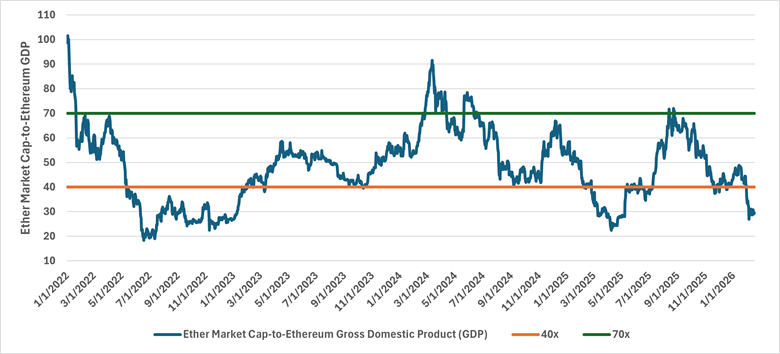
Source: Token Terminal, Charles Schwab daily data from 1/1/2022 through 2/18/2026.
For illustrative purposes only and are not intended to be, nor should they be construed as, a recommendation to buy, sell, or continue to hold any investment. Past performance is no guarantee of future results.
Ether may be more favorably positioned relative to other altcoins
This could be the year that ether finally puts its "scalability" debate to bed. The upcoming Glamsterdam network upgrade follows last fall's "Fusaka" upgrade. Additionally, major financial institutions are beginning to accelerate the shift of real-world assets onto blockchains. Given Ethereum's leading market share and standing as the industry standard smart contract blockchain, it is strongly positioned to benefit from increases in this activity. The crypto market has rewarded more speculative cryptocurrencies over the past three years, up until the bear market in the fall. Perhaps investors will reward ether's fundamentals in 2026.
The biggest crypto catalyst for 2026 would be the passing of the CLARITY Act (Digital Asset Market Clarity Act), as this could provide a tailwind for all cryptocurrencies. With greater regulatory clarity, more institutional investors may enter this market.
Alongside regulatory clarity, the potential for increased on-chain activity from tokenization comes at a time where ether is trading toward the low end of the trading range since January 2022, and reflects the weakness exhibited across the entire cryptocurrency market. As of February 18th, 2026, ether was 59% below its all-time peak set in August 2025, according to Bloomberg.
Absent a narrative, stocks will trade based on macro factors and cryptocurrencies shouldn't be any different. Given ether's cheap valuation, leading position to benefit from increased tokenization, and the potential to take control of the scalability narrative, in our view ether may be better positioned in 2026 relative to other altcoins.
Risks of investing in ether
Ethereum faces risk from competitors. Over the past few years, other smart-contract platforms have emerged that offer faster transaction speeds. If users were to move to one of these competitor networks, it could have a material impact on both the price of ether and the long-term viability of the Ethereum network. It also could be perceived to have "key-man" risk, as it is a founder-led protocol. If the founder, Vitalik Buterin, were to move on, investors could lose confidence in the network.
In addition to these ether-specific risks, investors should be aware of general cryptocurrency risks. All other cryptocurrencies are relatively new and due to their novel and unproven nature, reliable methods for estimating performance may not be available. The regulatory landscape for crypto is still evolving. Cryptocurrencies may be subject to potential encryption breaking, illiquidity and increased risk of loss. Theft, scams and fraud have been a factor to deal with, and if you decide to invest in crypto directly remember that there may not be an effective way to recover assets if they're stolen or lost.
Investing in cryptocurrencies involves risk, including the risk of total loss of principal invested. Cryptocurrencies such as bitcoin and ether are highly volatile, are not backed or guaranteed by any central bank or government; are not deposits; are not FDIC insured; are not SIPC protected; and lack many of the regulations and consumer protections that legal-tender currencies and regulated securities have. Due to the high level of risk, investors should view digital currencies as a purely speculative instrument. Cryptocurrency-related products carry a substantial level of risk and are not suitable for all investors. Investments in cryptocurrencies are relatively new, highly speculative, and may be subject to extreme price volatility, illiquidity, and increased risk of loss, including your entire investment in the fund. Spot markets on which cryptocurrencies trade are relatively new and largely unregulated, and therefore, may be more exposed to fraud and security breaches than established, regulated exchanges for other financial assets or instruments. Some cryptocurrency-related products use futures contracts to attempt to duplicate the performance of an investment in cryptocurrency, which may result in unpredictable pricing, higher transaction costs, and performance that fails to track the price of the reference cryptocurrency as intended. Additional risks apply.