Muni Bonds and Extreme Weather
Key takeaways: Muni bonds and extreme weather
- Extreme weather events are becoming more frequent and costly, creating financial pressures for some affected municipalities.
- Some regions face greater threat of droughts, floods, hurricanes, and wildfires, which can affect the muni-bond market.
- Higher-rated issuers may be better positioned to manage unexpected costs or revenue loss after a disaster.
- Shorter-term muni bonds can help limit long-term risks such as population decline or deteriorating local conditions caused by a weather event.
- A balanced mix of short- and intermediate-term munis may help support diversification, while lower-rated, long-term bonds in high-risk areas may warrant caution.
If it seems like climate-related disasters are happening more often in the U.S., it's because they are. An average of 23 weather disasters caused and average of $149.3 billion in damages each year from 2020 through 2024, according to the National Oceanic and Atmospheric Administration.
Under the weather
Although the number of billion-dollar weather events in 2024 was down slightly from a record high in 2023, the cost to repair damages was almost double.
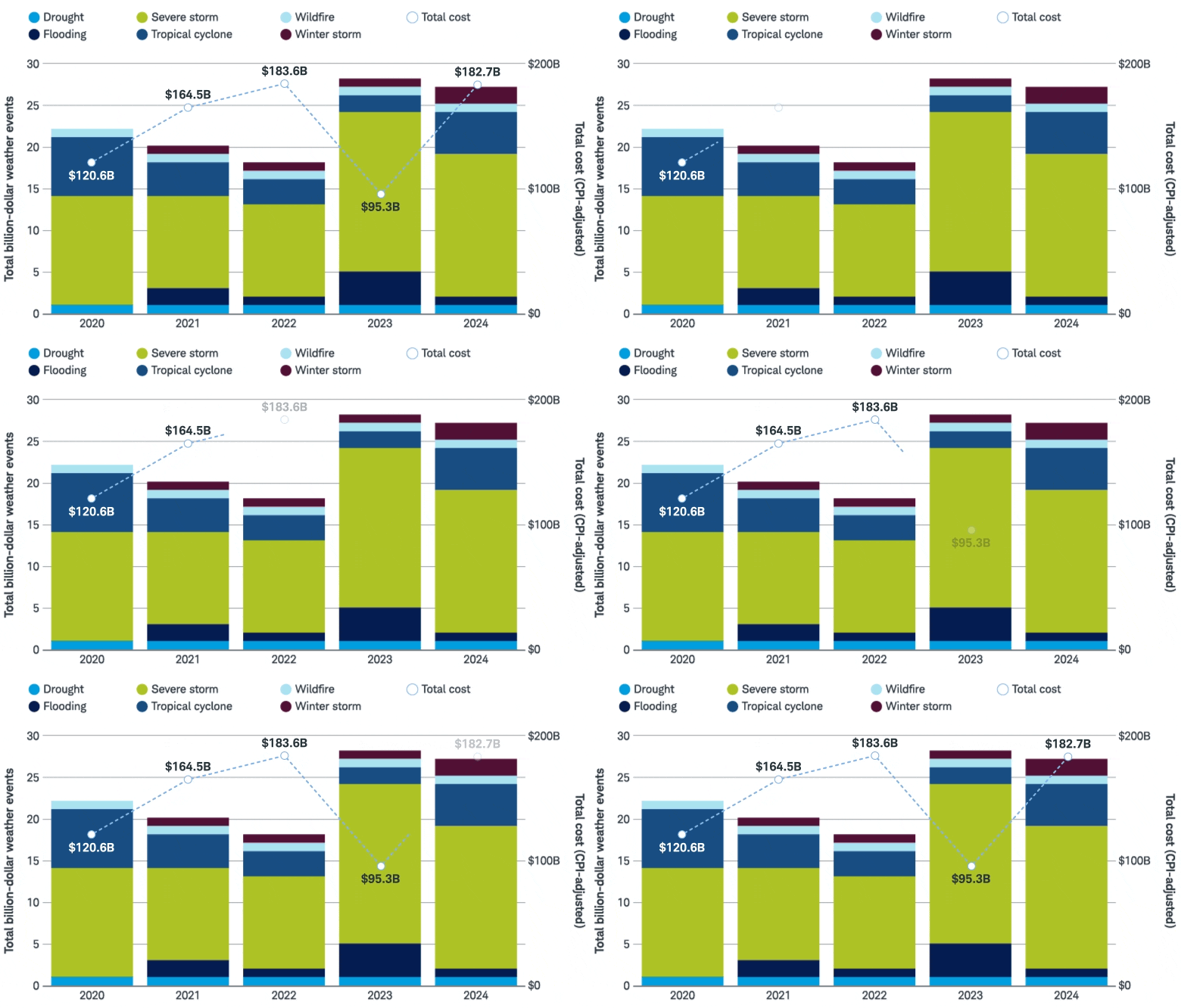
Source: National Oceanic and Atmospheric Administration.
NOAA National Centers for Environmental Information (NCEI) U.S. Billion-Dollar Weather and Climate Disasters (2025), DOI: 10.25921/stkw-7w73, as of 01/10/2025. (Note: The NCEI ceased updating information on the site after 2024.)
As a result, municipal bond investors shouldn't ignore the obvious: Natural disasters can have a financial impact on the municipalities in which they occur.
Let's take a look at how these extreme weather and climate events may affect muni-bond issuers, along with three steps investors can take to help protect their portfolios.
Uneven effects
The threat from climate-related disasters isn't uniform across the entire $4.5 trillion muni market (as of 06/16/2026 according to Bloomberg)—leaving municipalities that are prone to droughts, floods, hurricanes, or wildfires at risk of increased expenses, lower revenues, or both. And yields don't appear to reflect such risks.
For example, consider these three airport revenue bonds issued by Miami-Dade County, Dallas Fort Worth International (DFW), and Chicago O'Hare International Airport—all rated A+ by S&P Global Ratings and maturing at least 20 years from now. With a score of 71.53 (on a scale of 0 to 100), the weather and climate risk for Miami is arguably much greater than it is for DFW (53.94 for Dallas County and 39.64 for Tarrant County) or O'Hare (54.6 for Cook County and 15.15 for DuPage County),1 yet the average yield for all the outstanding bonds from the DFW and O'Hare airport bonds is 4.6% compared to an average yield of 4.8% for the Miami-Dade airport bonds, according to Bloomberg as of 6/30/26. In other words, investors in Miami munis are only being modestly compensated more than the other issuers, which could be the result of extreme weather or other factors.
How to respond
For muni investors concerned about the potential impact of weather-related disasters, we suggest:
- Diversifying geographically: If you invest in individual muni bonds, we recommend holding those from at least 10 issuers with different risks, including geographic. As a reminder, we suggest that most investors diversify their holdings nationally—with the possible exception of those in high-tax states such as California and New York, for whom in-state munis exempt from federal, state, and local taxes are particularly valuable.
- Favoring higher-rated issuers: Issuers with sound finances generally have the flexibility to deal with surprises. New York City, for example, was able to maintain its AA credit rating in the wake of Hurricane Sandy, the fourth-costliest storm in U.S. history. New Orleans, on the other hand, was rated near the low end of the investment-grade spectrum even before Hurricane Katrina, the costliest storm on record, hit in 2005—and S&P Global Ratings subsequently downgraded the city's general obligation (GO) bonds from BBB+ to a below-investment-grade rating of B. The city's GO bonds eventually rebounded to a rating of A+, but they took eight years to do so, as reported by Bloomberg in June 2021.
- Opting for shorter-term bonds: Weather events may lead to outmigration, which can result in a smaller tax base. After Hurricane Maria struck Puerto Rico in 2017, for example, the territory lost roughly 4% of its residents to outmigration, pushing its population to a 40-year low.2 Focusing on short-term munis can help reduce this particular risk by limiting your exposure to potential population declines and other deteriorating conditions.
Mix it up
Overall, we recommend a mix of short- and intermediate-term munis to help ensure adequate diversification. However, we caution against lower-rated, longer-term munis in areas where weather shocks are more probable.
1NOAA National Centers for Environmental Information (NCEI) U.S. Billion-Dollar Weather and Climate Disasters (2025), DOI: 10.25921/stkw-7w73.
2Antonio Flores and Jens Manuel Krogstad, "Puerto Rico's population declined sharply after hurricanes Maria and Irma," pewresearch.org, 07/26/2019.