Private Investments: Beyond the 60/40 Portfolio

For decades, the 60/40 portfolio has been a standard of wealth management.
Not only has an allocation of 60% to public stocks and 40% to fixed income assets delivered average returns over the past 50 years to the tune of 10.5% annually,1 but it has also helped ameliorate market crashes. A Morningstar analysis found a 60/40 portfolio suffered 45% less pain than an all-equity portfolio during major market downturns.2
Despite such past performance, investors have started to question the formula.
Schwab's 2025 Modern Wealth Survey found that 42% of respondents think the classic 60/40 portfolio is outdated. While they still believe in stocks and bonds for their core holdings, roughly two-thirds of those surveyed feel they must look beyond traditional investments for greater diversification and investing success. Indeed, Schwab Asset Management® believes returns from most major asset classes will underperform their long-term averages over the next decade.
Less-than-great expectations
Schwab Asset Management expects the mainstays of a diversified portfolio to underperform their historical averages over the next decade.
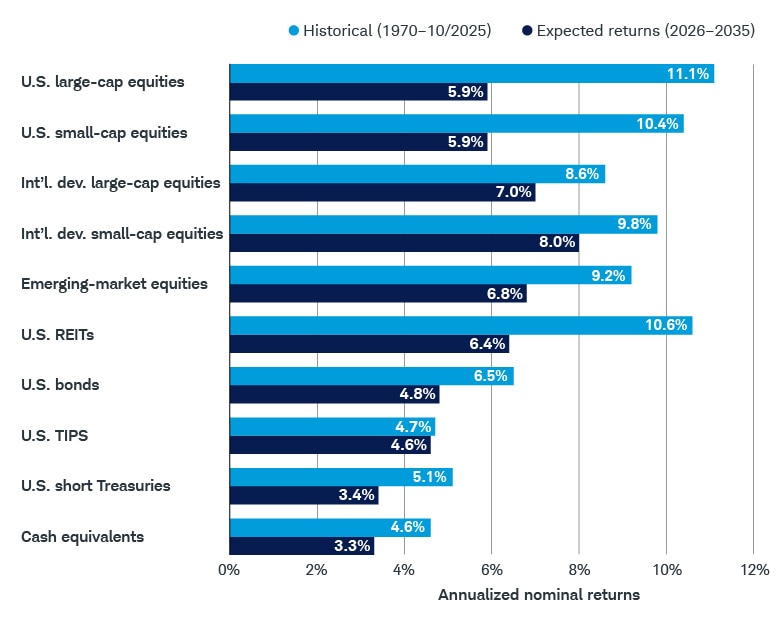
Source: Schwab Asset Management®. Data from 01/30/1970 through 10/31/2025.
Each bar represents an annualized 10-year nominal geometric return. The long-term historical average is calculated using an annualized geometric average based on monthly total return data from 01/30/1970 onward (unless otherwise noted). The expected returns represent Schwab Asset Management's long-term capital market expectations for 2026. Total return equals price growth plus dividend and interest income. Geometric returns account for the compounding nature of investment returns. Dividends are not guaranteed. Dividends and interest are assumed to have been reinvested, and the example does not reflect the effects of taxes or fees, which would cause performance to be lower. Numbers are rounded to the nearest one-tenth of a percentage point. Forecasts contained herein are for illustrative purposes only, may be based upon proprietary research, and are developed through analysis of historical public data. *Please see disclosures for information about the indexes used to represent asset classes.
"Investors who expect their traditional investments to perform in line with their historical averages may be disappointed," says Emre Erdogan, CFA®, head of quantitative innovation at Schwab Asset Management. "There's a case for looking beyond the public markets, particularly for those with long-term time horizons."
A different way
Enter alternative investments. Historically, such investments have been limited to institutional or accredited and qualified investors. Now, individual retail investors have greater access to these asset classes thanks to new fund structures with lower investment minimums—albeit with comparatively high fees and limited liquidity and transparency—and are increasingly embracing them to enhance their returns. Eligibility for these investments varies by firm and investment type, but generally retail investors must meet certain income and net worth criteria, in addition to investment minimums.
Let's examine the potential advantages and drawbacks of four types of alternative investment asset classes, for whom they might be appropriate, and how they could complement a traditional investment allocation of public stocks and bonds.
1. Private equity
Private companies often partner with private equity funds to finance growth and operations. These funds are managed by general partners (GPs) who identify, acquire, and manage a portfolio of privately held companies to generate returns for their investors, or limited partners. The businesses that GPs invest in or purchase can be early-stage companies, turnaround candidates, or more mature firms with recurring revenues and steady cash flows.
Traditional private equity funds employ what is called a "drawdown" structure, where investors commit to a large, up-front sum—often $5 million or more—that is drawn down, or paid into the fund, as the GP identifies investment opportunities. Investors generally receive distributions after companies within the fund are sold or go public.
However, the recent introduction of so-called evergreen funds allows investors to immediately put their capital into existing portfolios of private companies for investment minimums of $100,000 or less and periodically redeem a portion of their investment up to predetermined caps.
Private equity pros and cons
- Pros: Private equity funds may offer higher return potential than funds that invest in public companies. Over the 15-year period that ended in September 2025, the Cambridge Associates Global Private Equity Index, for example, outperformed the MSCI World Index by nearly 4.3 percentage points annually on a net basis3—owing in part to the higher returns investors demand for locking up their money for longer periods, known as the illiquidity premium.
- Cons: Even the latest fund iterations offer investors only limited access to their capital—say, on a predetermined schedule—and liquidity isn't guaranteed. "The underlying assets are still illiquid, so you'll never have the same kind of access to your capital as you do with publicly traded funds," says Ken Pennington, CFA®, director of alternative investments research at the Schwab Center for Financial Research. Such funds may also layer fees on top of underlying fund expenses, and performance fees may apply to unrealized gains.
- Pros: Private equity funds may offer higher return potential than funds that invest in public companies. Over the 15-year period that ended in September 2025, the Cambridge Associates Global Private Equity Index, for example, outperformed the MSCI World Index by nearly 4.3 percentage points annually on a net basis3—owing in part to the higher returns investors demand for locking up their money for longer periods, known as the illiquidity premium.
- Cons: Even the latest fund iterations offer investors only limited access to their capital—say, on a predetermined schedule—and liquidity isn't guaranteed. "The underlying assets are still illiquid, so you'll never have the same kind of access to your capital as you do with publicly traded funds," says Ken Pennington, CFA®, director of alternative investments research at the Schwab Center for Financial Research. Such funds may also layer fees on top of underlying fund expenses, and performance fees may apply to unrealized gains.
2. Private credit
Private credit investments fall into two broad categories: capital appreciation strategies with the potential to produce equity-like returns, and income-producing funds that may deliver higher yields than public markets.
The biggest piece of the private credit market is direct lending, which falls into the latter category and is similar to traditional bank lending but is negotiated directly with private investors. It expanded following the 2008 financial crisis, when stricter regulations forced traditional banks to pull back from lending to midsize businesses, which are often too large for standard small-business loans but too small to issue public bonds. Private lenders stepped in to fill the void, ultimately creating vehicles that retail investors have access to, like business development companies (BDCs) and interval funds.
Private credit pros and cons
- Pros: Private credit funds tend to pay relatively higher income than traditional fixed income investments because financing is privately negotiated and can potentially offer more favorable terms to the lender. As of December 2025, the Cliffwater Direct Lending Index, for instance, had returned an average 9.6% per year for the past 20 years, with interest income the main driver of returns.4 And unlike fixed-rate public bonds, which lose value when interest rates climb, private credit loans typically offer floating rates, helping to protect investors against inflation or rising rates.
- Cons: While floating-rate structures can boost private credit returns when interest rates rise, they can become a drag on performance when rates fall. Credit funds also carry greater credit risk: Midsize private companies tend to default more often than their public counterparts, and when borrowers struggle to make payments, funds may compensate investors with additional debt or equity (i.e., payments-in-kind) rather than cash. What's more, rising credit concerns, which reflect the perception of greater risk, can also trigger an uptick in redemption requests—as seen earlier this year, when widening credit spreads in the middle market decreased the net asset values of existing BDC loan portfolios, most notably in the software sector. "You really want to understand the companies and sectors that private credit managers are extending credit to," Emre says.
- Pros: Private credit funds tend to pay relatively higher income than traditional fixed income investments because financing is privately negotiated and can potentially offer more favorable terms to the lender. As of December 2025, the Cliffwater Direct Lending Index, for instance, had returned an average 9.6% per year for the past 20 years, with interest income the main driver of returns.4 And unlike fixed-rate public bonds, which lose value when interest rates climb, private credit loans typically offer floating rates, helping to protect investors against inflation or rising rates.
- Cons: While floating-rate structures can boost private credit returns when interest rates rise, they can become a drag on performance when rates fall. Credit funds also carry greater credit risk: Midsize private companies tend to default more often than their public counterparts, and when borrowers struggle to make payments, funds may compensate investors with additional debt or equity (i.e., payments-in-kind) rather than cash. What's more, rising credit concerns, which reflect the perception of greater risk, can also trigger an uptick in redemption requests—as seen earlier this year, when widening credit spreads in the middle market decreased the net asset values of existing BDC loan portfolios, most notably in the software sector. "You really want to understand the companies and sectors that private credit managers are extending credit to," Emre says.
3. Private real estate
These pooled investment vehicles raise money from investors to buy, develop, or finance real estate assets not traded on public markets, including apartments, hotels, offices, and warehouses. Depending on the type of property and strategy involved, investors can receive regular income based on cash flows from rents and operating income, capital appreciation, or a combination of the two. Investment minimums, once around $100,000, have dropped to as low as $25,000 over the past 20 years due to the rise of online real estate platforms, which expanded fractional ownership opportunities.
Private real estate pros and cons
- Pros: Private real estate may offer lower correlations to stocks and bonds—and some of the most tax-efficient income potential. Over the past two decades, average income returns have been stronger in U.S. private real estate than in either stocks or bonds.5 Private real estate also provides a potential inflation hedge since the income generated is correlated with rents, which have historically increased with inflation.
- Cons: Access to capital is likely to be locked up for extended periods, depending on fund structure; for traditional drawdown funds, it can be from 8 to 12 years, whereas for evergreen funds it's typically in the range of 12 to 36 months. Moreover, its price appreciation—as opposed to its income potential—doesn't stand out in any given year, which could lead to subpar total returns over time. For example, over the past 20 years ending September 2025, the NCREIF Property Index had an average annualized total return of just 6.62%.6 "That said, private real estate may offer greater diversification and a smoother ride since it's a long-term investment," Emre says.
- Pros: Private real estate may offer lower correlations to stocks and bonds—and some of the most tax-efficient income potential. Over the past two decades, average income returns have been stronger in U.S. private real estate than in either stocks or bonds.5 Private real estate also provides a potential inflation hedge since the income generated is correlated with rents, which have historically increased with inflation.
- Cons: Access to capital is likely to be locked up for extended periods, depending on fund structure; for traditional drawdown funds, it can be from 8 to 12 years, whereas for evergreen funds it's typically in the range of 12 to 36 months. Moreover, its price appreciation—as opposed to its income potential—doesn't stand out in any given year, which could lead to subpar total returns over time. For example, over the past 20 years ending September 2025, the NCREIF Property Index had an average annualized total return of just 6.62%.6 "That said, private real estate may offer greater diversification and a smoother ride since it's a long-term investment," Emre says.
4. Hedge funds
Since the middle of the 20th century, hedge funds have offered investors a way to mitigate market downturns and other risks by taking offsetting positions. The oldest hedge funds—long/short equity funds—take long positions in undervalued stocks and short positions in overvalued ones. Other popular strategies involve attempting to profit from price differences between related investments (relative value), investing in global economic trends (global macro), and taking positions on corporate events like mergers (event driven).
While many mainstream hedge funds require at least $1 million in committed capital and can lock up your investment for years, a newer crop enabled by partnerships with fintechs has lower thresholds and greater liquidity. These include funds-of-funds—which invest in a portfolio of hedge funds rather than directly in stocks, bonds, and other securities—and funds that use third-party platforms, with minimums as low as $100,000. Liquid alternatives—exchange-traded funds and mutual funds that attempt to mimic hedge fund strategies while offering daily liquidity—start as low as $5,000.
Hedge funds pros and cons
- Pros: Hedge funds can offer downside protection, excess returns, lower volatility, and diversification from traditional stocks and bonds. Hedge fund managers' use of derivatives and leverage can amplify gains.
- Cons: Derivatives and leverage can magnify losses as well as gains; high fees can significantly reduce net returns, especially given that performance fees are typically layered on top of management fees; and hedge funds don't have to disclose their holdings the way public funds do, leading to a lack of transparency. "You really need to think about what your goals are so you can find the right strategic alignment," says Eric Tarkin, director of asset allocation and model portfolios at Schwab Asset Management.
- Pros: Hedge funds can offer downside protection, excess returns, lower volatility, and diversification from traditional stocks and bonds. Hedge fund managers' use of derivatives and leverage can amplify gains.
- Cons: Derivatives and leverage can magnify losses as well as gains; high fees can significantly reduce net returns, especially given that performance fees are typically layered on top of management fees; and hedge funds don't have to disclose their holdings the way public funds do, leading to a lack of transparency. "You really need to think about what your goals are so you can find the right strategic alignment," says Eric Tarkin, director of asset allocation and model portfolios at Schwab Asset Management.
Finding your fit
When it comes to slotting private investments into your portfolio, there are no hard-and-fast rules about whether or how much to allocate. "We tend to use a core-satellite approach when allocating to alternative or nontraditional investments," Eric says. "That means we think that the bulk or core of a portfolio should still comprise traditional public investments, but investors can consider a modest allocation to riskier satellite holdings like private investments."
Generally speaking, private equity forms part of an equities allocation and private credit part of a fixed income allocation. Private real estate can draw from an investor's allocation to income-oriented inflation-hedging assets, such as real estate investment trusts (REITs), if there is one.
Hedge fund allocations are a bit trickier because they depend largely on the strategy involved and the intended role in the portfolio. Positions designed to boost returns should likely be part of an investor's equities allocation, for instance, while those meant to reduce drawdowns or hedge risk should count toward the fixed income allocation since it plays a more defensive role.
The more difficult decision, perhaps, is picking the right manager. Private investment managers tend to be far more varied in their results than their public fund counterparts. In private equity, for instance, the difference between a manager in the top quartile of performers versus one in the bottom quartile can be nearly 30 percentage points.
How managers measure up
Across most asset classes, performance varies widely between the top and bottom managers—but the difference is especially dramatic within private investments.
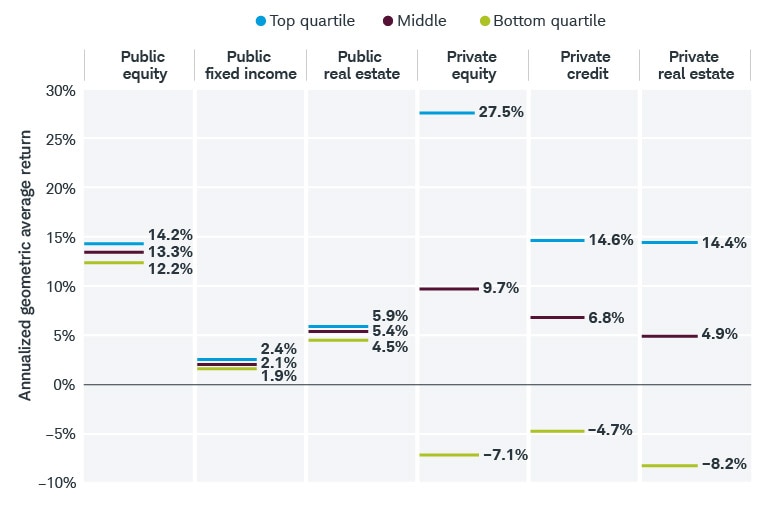
Source: Cambridge Associates (private markets) and Morningstar (public markets).
Private markets: Figures are the equal-weighted average, across vintage years 2010–2018, of each vintage's pooled time-weighted return by quartile. For each quartile, quarterly pooled returns = (ending NAV − beginning NAV + contributions + distributions) ÷ beginning NAV, i.e., the combined, capital-weighted return of all funds in that quartile. Returns are net of fees and expenses. Note, the first three quarters of each vintage are excluded because fund counts have not yet reached their full complement and are not reflective of manager's performance. Private Equity (Buyout, Fund of Funds, Growth Equity, Secondary Funds, and Venture Capital); Private Credit (Credit Opportunities, Senior Debt, Subordinated Capital, and Control-Oriented Distressed); Private Real Estate (Real Estate). Public markets: Annualized 10-year returns (geometric mean) for 01/01/2016–12/31/2025, computed per fund within Morningstar open-end categories, then ranked into quartiles across the cross section of fund-level returns. Public Equities (U.S. Large Blend), Public Fixed Income (U.S. Intermediate Core Bond), and Public Real Estate (U.S. Real Estate). Past performance is not indicative of future results, and there can be no assurance that historical trends will continue.
"Your advisor can help you balance the trade-off between access to your money and your long-term return potential," Emre says. "Since private investing typically locks up your capital, often for long periods, the cost of making the wrong choice compounds over time, so there's an extra incentive to get it right."
1Schwab Center for Financial Research. Stocks are represented by the S&P 500® Index and bonds by the Bloomberg U.S. Aggregate Bond Index, total return.
2Emelia Fredlick, "The 60/40 Portfolio: A 150-Year Markets Stress Test," morningstar.com, 03/19/2026.
3US Private Equity: Index and Selected Benchmark Statistics, cambridgeassociates.com, 09/30/2025.
4"Cliffwater Direct Lending Index Data Supports Strength of Private Credit," cliffwater.com, 03/31/2026.
5Mike Sobolik, "The historical benefits of US private real estate," invesco.com, 03/10/2026.
6Caroline Clapp, "Senior Housing Posts Highest NCREIF Property Type Return in Third Quarter and Year-to-Date 2025," nic.org, 11/18/2025.
Discover more from Onward

Keep reading the latest issue online or view the print edition.