4 Questions About the Bonus Senior Tax Deduction
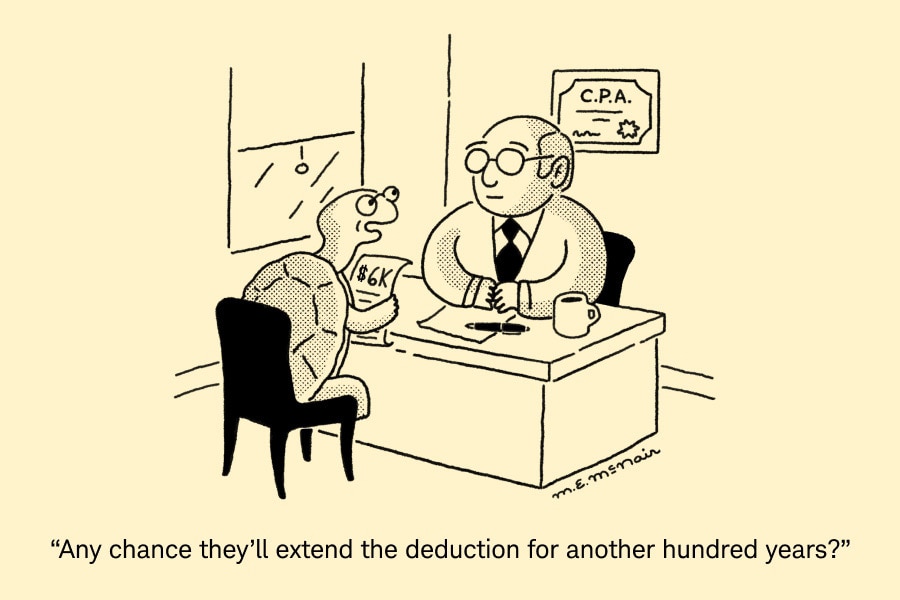
Passage of the One Big Beautiful Bill Act created a $6,000 senior tax deduction for people ages 65 and older that is in effect for tax years 2025 through 2028. Schwab's resident tax expert weighs in on recent client questions around this new deduction—and how to get the most out of it.
Am I eligible if I don't itemize?
"This is a rare instance of a deduction being available to both those who itemize and those who take the standard deduction," says Hayden Adams, CPA, CFP®, director of tax planning and wealth management research at the Schwab Center for Financial Research.
"If you itemize, you still get your normal itemized deductions in addition to this new deduction. For those who take the standard deduction of $15,750 per person in their 2025 taxes, the $6,000 bonus deduction stacks on top of the extra deduction seniors are already getting: $2,000 for single filers and $1,600 per eligible spouse whether they file jointly or separately.
"That means an eligible single taxpayer can deduct up to $23,750 [$15,750 + $2,000 + $6,000] and a married couple where both spouses qualify can deduct up to $46,700 [$31,500 + $3,200 + $12,000] on their 2025 taxes."
Are there any income restrictions?
"Yes," Hayden says. "The deduction starts to phase out for singles whose modified adjusted gross income (MAGI) exceeds $75,000, with the deduction completely phased out at $175,000. For married couples, the deduction phaseout starts at $150,000 and disappears altogether at $250,000."
Are there any strategies to maximize its benefit?
"Absolutely," Hayden says. "Rather than a way to reduce your tax bill, I suggest thinking of it as a way to improve your tax situation. Let me explain.
"Say last year's tax bill was manageable, and this year you're landing in about the same place before factoring in the additional $6,000 deduction. You could use that deduction to cover the taxes of a $6,000 Roth conversion and keep your overall tax bill roughly the same, because the bonus deduction effectively offsets the taxable income created by the conversion. Converting funds to a Roth IRA means future withdrawals could be entirely tax-free, plus Roths aren't subject to the required minimum distributions mandated by the IRS beginning at age 73 or 75, depending on your birth year.
"Likewise, if you have significant capital gains you've been putting off, you could strategically realize up to $6,000 per year through 2028 to maximize the full benefit of the deduction—a great option if your portfolio needs rebalancing or you have a highly concentrated position in your employer's stock."
Is the deduction likely to be made permanent?
"No one knows the future, but this is already a really popular deduction, so I wouldn't be surprised if it's extended or made permanent," Hayden says. "Retirees vote, and they're likely going to put pressure on whoever is in office to keep it."
Discover more from Onward
Keep reading the latest issue online or view the print edition.