STAX Generational Trends: Boomers, Gen X De-risk

Even with the S&P 500® surging more than 12% in April, both older and younger generations took a more conservative investing approach. High oil prices, stubborn inflation, and ongoing tensions in the Middle East weighed on sentiment after a bullish first few months of 2026.
The Schwab Trading Activity Index™ (STAX)—which analyzes Schwab client activity to gauge investor sentiment—fell 10.6% month over month to 50.1 in April, its largest decline in a year. However, April's STAX score was still the third highest over the past 12 months, and tax season may have played a role in the downturn.
"Each April, we tend to see client selling in advance of Tax Day and reinvesting afterward," Joe Mazzola, head trading and derivatives strategist at Schwab, explained.
Gen X (born 1965 to 1980) maintained the most bullish positioning in April, followed by Baby Boomers (born 1946 to 1964), the Silent Generation (born before 1946), and then Millennials (born 1981 to 1996). Gen Z (born 1997 to 2012) and Gen Alpha (born 2013 to 2024) remained far more cautious.
Still, looking at month-over-month changes to STAX scores, it was older generations that pulled back the most. Baby Boomers and Gen X declined 11.6%, the Silent Generation fell 10.5%, and Millennials dropped 9.2% in their STAX scores versus March.
Gen Alpha and Gen Z's STAX scores, meanwhile, fell just 4.4% and 6.5%, respectively.
"Part of that could be attributed to tax selling, especially since traders' STAX scores declined more than investors'," Mazzola said, noting that there's also evidence of "de-risking without abandoning equities." To his point, investors rotated out of risk-on sectors like tech and into defensive sectors like consumer staples in April. Less-volatile diversified ETFs were also near the top of the buy list last month.
Gen Z also overtook Gen Alpha as the most bearish generation in April, but it's worth noting that many Gen Alpha brokerage accounts are managed by guardians, who may naturally take a more conservative approach while managing their dependents' money.
April's moves in the STAX Trading Activity Index mirrored broader consumer confidence trends. Older generations' confidence plunged last month, while younger generations remained more optimistic, according to the Conference Board's Consumer Confidence Index®.
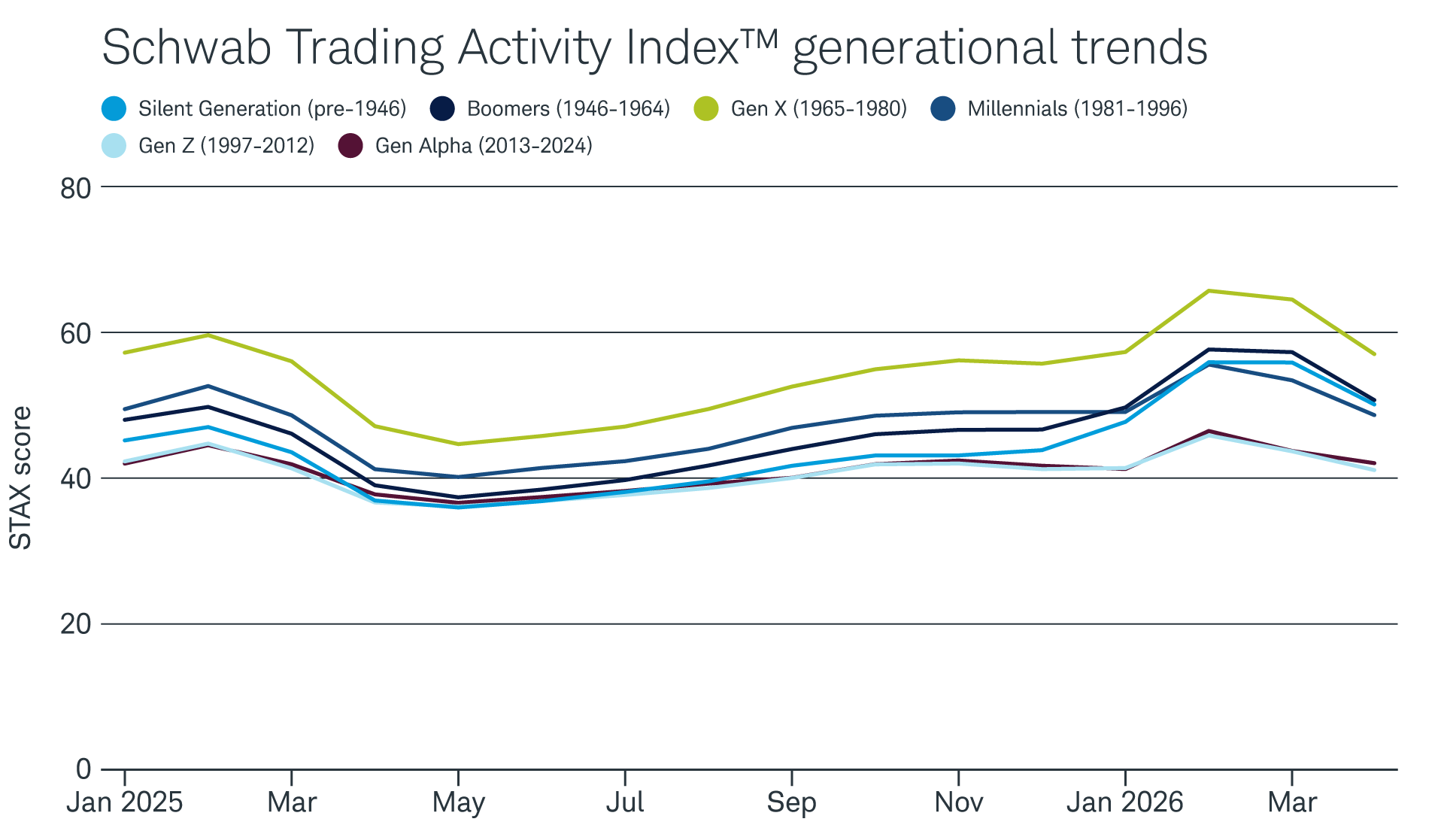
Source: Schwab
For illustrative purposes only.
STAX reports on what traders are actually doing with their money, not just what they say they're doing. Want to dig deeper into the latest retail investor trading activity? Check out April's STAX release.