STAX Generational Trends: A Silent Record

Key takeaways
- The Schwab Trading Activity Index rose 2.47% to 58.92 in September, reversing August's decline and finishing just below July's multiyear high.
- Trading activity generally increased more among older generations and wealthier clients, with the Silent Generation reaching a record high and ultra-wealthy investors remaining the most bullish.
- Despite the rise in actual trading activity, survey results showed widespread investor caution, highlighting a disconnect between what clients did and how they said they felt.
A Federal Reserve rate hike, an ongoing conflict in the Middle East, and surging Treasury yields weren't enough to dissuade investors from leaning into the stock market last month. The Schwab Trading Activity Index™ (STAX)—which analyzes Schwab client activity to gauge investor sentiment—rose 2.47% to 58.92 in September, reversing August's decline to finish just below July's multiyear high.
Nearly every generation saw their STAX score rise during the month, and an interesting pattern emerged: The older the generation, the more their STAX score jumped.
The Silent Generation's (born before 1946) score surged 4.20% to 58.00—a record high for this age group since Schwab began tracking generational data in June 2024. Meanwhile, Baby Boomers' (born 1946 to 1964) score rose 3.02% to 59.54, and Gen X's (born 1965 to 1980) score was again the highest among all generations, popping 2.97% to 67.44.
"The generational trading pattern suggests experience and financial capacity may be influencing how clients respond to uncertainty," said Joe Mazzola, head trading strategist at Schwab. "Older generations increased their market exposure most aggressively, while younger investors—who may have less capital and a longer list of competing financial priorities—appeared more measured."
Activity was less enthusiastic among younger generations. Millennials' (born 1981 to 1996) STAX score rose 2.11% to 58.04, while Gen Z's (born 1997 to 2012) edged up just 0.85% to 47.00. Gen Alpha's (born 2013 to 2024) declined 0.25% to 47.86. (Note: A significant portion of Gen Alpha's trading is likely done by guardians, who could be more risk-averse with their dependents' money.)
Although clients' trading activity was generally more bullish last month, our latest client survey revealed respondents are far from optimistic. Roughly 50% said they were bearish, while just 17% said they were bullish. Nearly 90% of respondents also noted they were concerned about the market impact of the conflict in the Middle East, and 76% said they expect at least one more Fed rate hike this year. For now, hard trading activity data and soft survey data seem to be sending conflicting messages.
STAX generational trends
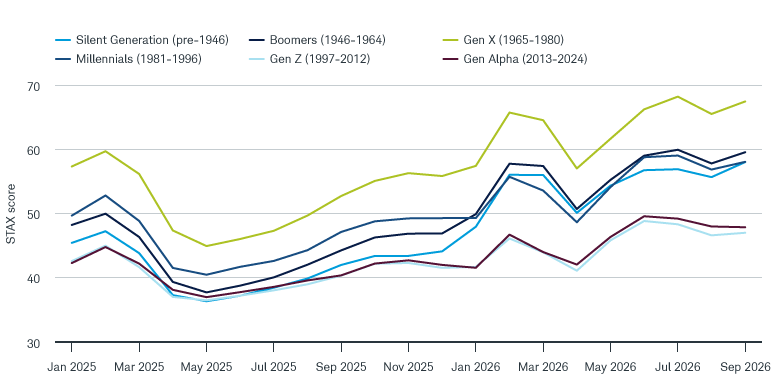
Source: Schwab
For illustrative purposes only.
Looking at STAX scores by assets under management (AUM), ultra-wealthy clients continued to be the most bullish. Every AUM tier saw their STAX score rise in September, and a similar trend emerged: Generally, the wealthier the client, the more their score rose. Here's how each tier fared.
|
AUM tier |
Latest STAX score |
Month-over-month change |
|---|---|---|
|
>$500M |
80.60 |
7.33% |
|
$100M – $500M |
74.11 |
4.63% |
|
$10M – $100M |
66.46 |
4.89% |
|
$5M – $10M |
60.29 |
4.61% |
|
$1M – $5M |
53.79 |
3.66% |
|
$500K – $1M |
53.46 |
2.74% |
|
$100K – $500K |
57.78 |
2.75% |
|
$10K – $100K |
61.67 |
1.68% |
|
$2K – $10K |
59.65 |
0.59% |
STAX reports on what traders are actually doing with their money, not just what they say they're doing. For more on the latest retail investor trading activity, check out September's STAX release.