Utilities Lose Defensive Touch as AI Ignites Rally
Teens learning to "drive defensively" stay clear of obstacles like potholes and closely monitor traffic for unexpected maneuvers.
Investors, too, typically learn to build portfolios with some defensive moves. When the market heats up, they're often told to place some of their funds in stocks or sectors that tend to be less affected when the road turns rough due to recessions or geopolitical storms.
Traditionally, that means steering toward sectors like utilities, consumer staples, and health care. The old argument is that people still need to brush their teeth, take out the garbage, and turn on the lights even in challenging economic times. That's one reason companies selling things like toothpaste, waste removal, and electricity often stay on the road when the broader market veers toward the bushes.
The flip side is that these defensive names rarely do as well when the economy recovers and the rally accelerates for tech, communication services, and sexier growth stocks.
While that rule isn't ironclad, it generally worked over the decades. Until now.
Power-hungry AI fuels utility market rally
For the last two years, the S&P 500 utilities sector—often considered the market equivalent of landing on a dull property like Electric Company or Water Works in Monopoly—grew exciting, thanks to its AI exposure, and kept close pace with a rallying broad market. The utilities rally accelerated in late November after AI-giant Nvidia reported strong earnings and guidance.
"Nvidia's earnings helped support the AI spend narrative, which is providing a boost to the utilities sector," said Joe Mazzola, head trading and derivatives strategist at Schwab. "This sector was already up sharply year to date, and fresh off the news, it had 25 of its 31 components trading higher."
This calls into question whether investors can continue to think of utilities as a defensive sector or if they need to seek stability elsewhere. It's also unclear if this change is temporary or permanent, and how prevalent it really is across a sector where only a handful of firms benefit from AI data center build-out activity.
Companies like Microsoft (MSFT), Alphabet (GOOGL), Amazon (AMZN), and Meta Platforms (META) are spending hundreds of billions a year building data centers, and that includes budgeting for vast amounts of electric power.
This puts companies like NRG Energy (NRG), Vistra (VST), and Constellation Energy (CEG) in the spotlight as mega-cap firms work with them to obtain the energy needed to run the complex chips that power the cloud. NRG Energy has been among the best-performing stocks in the S&P 500 index®(SPX) this year and remained up nearly 80% by mid-November. That's almost double the gain of AI-chip leader Nvidia (NVDA) so far in 2025.
With the AI tailwind driving shares higher, utilities kept pace with the S&P 500 in 2024 and thus far in 2025, closely mirroring the broad-market barometer's price action. Through mid-November, the S&P 500 was up 14%, but the utilities sector was outpacing even the tech-heavy Nasdaq 100® (NDX). In 2024, the S&P 500 rose 25% and utilities rose about 24%, according to S&P Global data.
That contrasts sharply with just a few years earlier. As recently as 2023, the S&P 500 rose 26%, while utilities fell 7%. The year before that was a bad one for the S&P 500, which fell 18% in 2022. But utilities filled their defensive role by rising about 1%, S&P Global said.
Investors who had the foresight to keep a small portion of their portfolio in utilities in 2022 would have possibly suffered slightly smaller losses than if they'd simply tracked the S&P 500. The same held true in 2018—a previous down year for the S&P 500—when it fell 4.4%, while utilities rose about 4%.
Though correlation isn't causation, the recent run-up in utilities during the AI boom appeared to set it apart from consumer staples, another sector traditionally seen as defensive. While staples posted gains in 2024 and 2025, they have notably trailed the S&P 500.
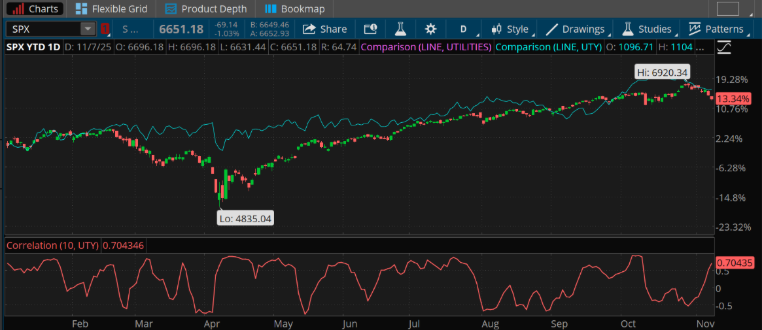
Schwab investors can track correlation between sectors and indexes on the thinkorswim® platform. Over the last 20 years, the tech sector's performance has most closely correlated with the S&P 500. Utilities have correlated the least.
This year, the general correlation has grown closer, with the utilities sector spending much more time in correlation with the direction of the S&P 500 than in a year like 2018 or 2022 when they were out of sync for long periods.
As Bloomberg pointed out earlier this fall, "AI mania risks spoiling a classic haven."
The rally is also spoiling another investment strategy tied to utilities and other defensive sectors. Historically, utility companies have paid investors generous dividends. But as stock prices rise, dividend yields fall, unless companies raise them.
Utilities as a sector still sported a hefty dividend yield of 2.73% as of November 2025, but that was down from 2.85% a year earlier and below what an investor could get from a 10-year Treasury note or many short-term CDs from their local bank. The historic average yield for utilities is close to the current level, but the sector yield has tracked above 3% at times in recent decades.
Are utilities irrevocably tied to AI?
Though companies like Constellation Energy and Vistra rallied heavily this year on their AI ties, the entire sector isn't necessarily going up or down with the fortunes of the data center industry. Like Baskin-Robbins, the S&P Utilities Sector Index features 31 flavors—companies, not ice cream—and not all are in the AI business. Most could likely benefit from AI efficiencies—as many would argue is true for many companies regardless of industry—but several firms in utilities benefit more than others from the AI boom itself. That's showing up in year-to-date stock performance.
As of mid-November, about half of the utilities sector was trending ahead of the S&P 500 year to date, led by the 79% gain for NRG Energy, 55% for Constellation Energy, 33% for American Electric Power (AEP), and nearly 30% for Vistra.
Arguably at the center of the AI story for utilities is nuclear power. Power demand from data centers is on track to grow more than 160% by 2030 from 2023, Goldman Sachs (GS) said in a recent report. That's constrained to some extent by company and consumer demand for power supplied by coal, natural gas, and alternatives like wind and solar.
"The proliferation of AI data centers has boosted investor confidence in future growth in electricity demand at the same time as big tech companies are looking for low-carbon reliable energy," according to Goldman Sachs. "This is leading to the de-mothballing of recently retired nuclear generators, as well as consideration for new larger-scale reactors."
Big tech companies signed new contracts for more than 10 gigawatts of possible new nuclear capacity in the one-year period leading up to early 2025, and Goldman Sachs Research sees potential for three plants to be operational by 2030.
That's one reason investors have gravitated toward companies in the utilities sector with a nuclear component, including Vistra, Constellation Energy, Duke Energy (DUK), NextEra Energy (NEE), NRG Energy, Dominion Energy (D), and Entergy (ETR). All these stocks had either kept pace with or outperformed the S&P 500 year to date as of mid-November. The sector has even fueled its own utilities version of a "meme" stock, as shares of nuclear power firm Oklo (OKLO) skyrocketed this year despite no earnings or revenue.
While many utilities have enjoyed a 2025 rally, others lagged, especially the more traditional power firms. Large-cap names like Southern Company (SO), DBA Sempra (SRE), and Pacific Gas & Electric (PCG) are well behind the S&P 500 index, perhaps a sign that AI excitement hasn't permeated the entire sector.
Though excitement is what some investors seek in growth stocks, it's not necessarily what they may have bargained for with utilities. Beta, which measures volatility of returns, has traditionally been quite low for utilities, less than half the 1.0 beta of the market as a whole. That's still the case for some utility firms like Pacific Gas & Electric and Southern Company, which are both well below 1.0 on the beta scale. However, beta is now above average for Constellation, Vistra, and NRG Energy, possibly a sign of AI-related volatility becoming more of a feature for parts of the sector.
Will utilities ever resume their place in the defensive realm?
Naturally, investors who want to tilt toward less volatility likely want to know if utilities have now permanently switched from the slow lane to the racetrack, meaning they're no longer seen as a quieter place to put money while collecting dividends.
One argument suggests investors see the current AI build-out like the construction of a building. The foundation is dug, the frame is going up, the beams are getting placed, and the power wires are being connected. It's now, when the building is still going up and it's unclear how much power it needs, when utilities might see the most dramatic impact. Once the AI infrastructure is complete, it will be time to paint the walls and hang the pictures, which may mean more of a traditional role for utilities simply keeping the power supply going.
At that point, utilities might resume being a place where people go to play defense. No one knows exactly how much all this will factor into ultimate increases in demand, but it's worth noting that data center workload nearly tripled between 2015 and 2019, but data center electricity consumption was flat, according to a study in Goldman's report. That implies the real benefits for utilities sector growth is when the house is under construction, not after it's finished.
That may mean defensive drivers might want to consider steering carefully through this neighborhood for at least a few more years.