3 Ways to Evaluate Dividend-Growing Stocks

For long-term investors seeking steady income and growth, stocks that consistently raise their dividends can deliver both.
"Such companies are often in growth mode, giving them the confidence to increase their payout obligation," says Adam Lynch, director of equity modeling at the Schwab Center for Financial Research.
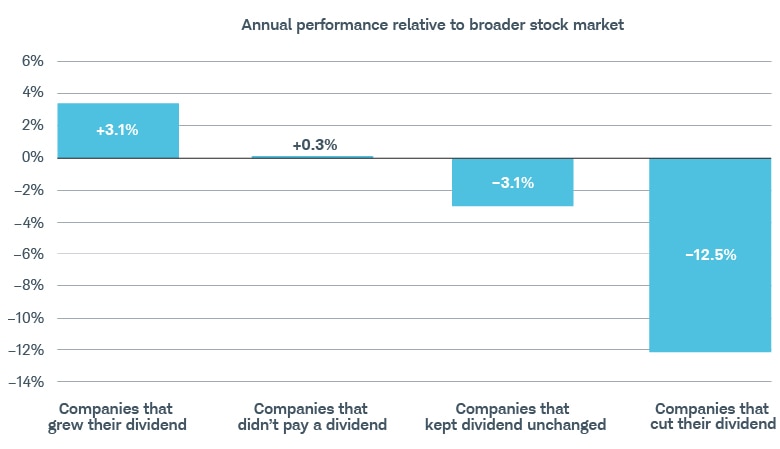
While past performance is no guarantee of future results—there's always a risk of dividend cuts or a drop in price that could lead to losses—dividend growers historically have tended to outperform payers that keep their dividends flat or reduce them over time.
"Our research has found that over the past 20 years, stocks that grew their dividends outperformed the market by 3.1% annually, on average," Adam says, "whereas stocks that cut their dividends underperformed the market by 12.5%, on average."
Growing prospects
Over the past 20 years, dividend growers provided excess returns of 3.1% annually.
Source: Schwab Center for Financial Research. Data from 12/31/2005 through 12/31/2025.
The U.S. stock market is represented by the Russell 3000® Index. Past performance is no guarantee of future results. There are risks associated with investing in dividend-paying stocks, including but not limited to the risk that stocks may reduce or stop paying dividends. Indexes are unmanaged, do not incur management fees, costs, and expenses, and cannot be invested in directly.
So, what should investors look for when evaluating dividend growth?
1. Growth rate
"According to our research, stocks with higher compound annual growth rates (CAGR)—the rate of return an investment would need to grow annually to reach its value over a period of time—generally outperform those with lower growth rates," Adam says.
For example, from December 30, 2005, to December 31, 2025, companies in the Russell 1000® Index with a 3-year CAGR of more than 25% averaged an annual return of 8.0%, while those between 15% and 25% averaged a 6.8% annual return, and those between 5% and 15% averaged a 5.5% annual return.
To research dividend-growing stocks, log in to Schwab's Stock Screener. Under Dividends, select 3-Year Dividend Growth Rate and choose one or more ranges.
2. Growth trend over time
"If a company grew its dividend by 10% annually over the past three years but that growth was volatile, with big increases for one or two quarters followed by periods of stagnation, you might want to look elsewhere if your primary goal is reliable income," Adam says.
That said, some companies pay special dividends that can skew their payout picture. "In that case, you want to look at the consistency of the regular dividend payout over time, rather than the total payout," Adam says, "because special dividends aren't something you can count on."
To view a stock's dividend history over time, log in to log in to Schwab's Research Tools, click Stocks, then enter its ticker symbol in the search box. Scroll down to Dividends and click + Show More.
3. Payout ratio
Examining a stock's payout ratio—the percentage of earnings that's paid to shareholders as dividends—can help determine dividend sustainability. "A company whose payout ratio tops 80% has little room to pay down debt or invest in more growth, which could indicate weakening underlying financials," Adam says.
You can find a stock's Payout Ratio by clicking + Show More under Dividends and scrolling down to Statistics.
For income investors, inflation's erosion of purchasing power can make companies with growing dividend payouts particularly attractive. "A steady increase in dividends can help your income stream keep pace with inflation," Adam says.
Discover more from Onward

Keep reading the latest issue online or view the print edition.