What Are the Magnificent 7 Stocks?
Key takeaways
- The Magnificent Seven stocks are Nvidia, Alphabet, Apple, Amazon, Meta Platforms, Microsoft, and Tesla.
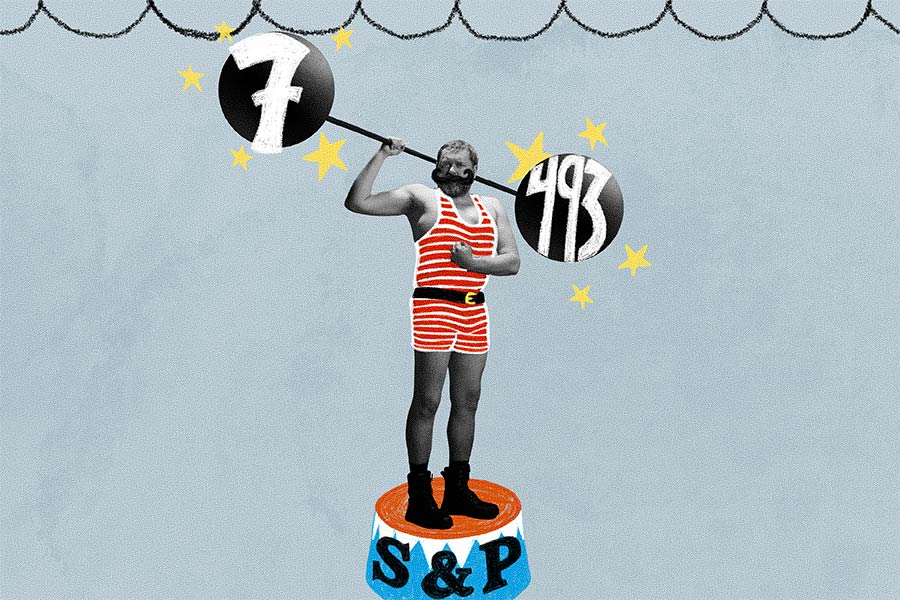
- These stocks make up about 34% of the market capitalization of the S&P 500® Index and can frequently influence the index on a given day.
- The Magnificent Seven's moniker was coined in 2023 and succeeded other past nicknames like FAANGs and Nifty 50.
- Anyone buying an S&P 500 index fund is also buying heavy exposure to Magnificent Seven stocks.
- Though the Magnificent Seven are often thought of as a single entity, each company is different and responds differently to fundamental developments.
Just as every generation "throws a hero up the pop charts," as Paul Simon sang, every decade brings a new set of icons to the stock market. In the 1970s, it was the "Nifty 50." In the '90s, it was the "Four Horsemen" of tech. More recently, "FAANG" stocks took charge before giving way to this decade's "Magnificent Seven." The future will likely bring new catchy names to investors' lips. The "Noble Nine," anyone? But for now, the Magnificent Seven (or Mag 7) doesn't seem to be going away despite rumors to the contrary.
What are the Magnificent 7 stocks?
The Magnificent Seven are a group of U.S. large-cap stocks—Alphabet, Amazon, Apple, Meta Platforms, Microsoft, Nvidia, and Tesla—that have driven a disproportionate share of U.S. stock market gains. Coined in 2023, the name echoes the title of a popular 1960 Western movie.
| Company | Ticker | Stock sector |
|---|---|---|
| Alphabet | GOOGL, GOOG | Communication services |
| Amazon | AMZN | Consumer discretionary |
| Apple | AAPL | Information technology |
| Meta Platforms | META | Communication services |
| Microsoft | MSFT | Information technology |
| Nvidia | NVDA | Information technology |
| Tesla | TSLA | Consumer discretionary |
While only Apple, Microsoft, and Nvidia fall into the "information technology sector" by S&P's definition, all seven are technology-related companies. Together they span cloud computing, e-commerce, social media, digital advertising, consumer hardware and services, artificial intelligence (AI), semiconductors, and electric vehicles.
How much of the S&P 500 do the Magnificent 7 stocks make up?
The Magnificent Seven's combined market capitalization was nearly $24 trillion by August 2026, representing about 34% of the approximately $70 trillion capitalization of the S&P 500® Index (SPX). That means anyone buying an S&P 500 index fund essentially puts 34% of their investment in just seven of the 500 companies. Many investors who think they're being conservative by buying index funds may not realize how heavily exposed to the Magnificent Seven they are.
"All investors should pay attention to the performance of these names because they have such a great impact on the overall market performance given their market cap weightings," said Alex Coffey, senior trading and derivatives strategist at Schwab. "These companies are also on the forefront of AI innovation, which may have a tremendous impact on the economy in the coming months and years. There are many sessions where these stocks are almost entirely responsible for the overall market's movement, so that makes them impossible to ignore."
Why do Mag 7 stocks matter to investors?
Investors keep an eye on the Magnificent Seven because they make up roughly a third of the SPX, and that outsized weight can act like a tether, keeping the overall market's path firmly tied to the fortunes or misfortunes of this handful of stocks and the many other names that tend to rise and fall with them.
That kind of concentration isn't unheard of. One example is the FAANGs—Facebook (now Meta), Apple, Amazon, Netflix (NFLX), and Google (now Alphabet)—which approached such influence a decade ago. Another is General Electric (GE), which formed 4% of the total SPX market cap around 2000.
In addition to stock market influence, the Magnificent Seven have an increasingly heavy impact on the U.S. and global economy.
In 2026, AI spending in the United States is expected to be around $800 billion, possibly rising above $1 trillion in years to come, per Goldman Sachs. By mid-2025, AI spending—by Magnificent Seven firms and others—accounted for 25% of U.S. gross domestic product (GDP) growth, according to Bloomberg. Large spenders include Amazon, Microsoft, Meta, and Alphabet, with each committing tens of billions of dollars a year. Apple has largely resisted the splurge, while Tesla spends heavily on AI. Nvidia tends to benefit from the spending.
AI spending now represents roughly 8% of U.S. GDP, Bloomberg reported. That tops the 6.5% of U.S. GDP formed by spending on IT equipment, software, and research and development (R&D) back in 2000 before the so-called internet, or dot-com, bubble popped. This means the health of the Magnificent Seven and the companies they buy from arguably has an outsized influence on the health of the market and, potentially, the overall U.S. economy.
How to invest in Mag 7 stocks
Investing in the Magnificent Seven can be as simple as buying an S&P 500 index fund, which was 34% exposed to those seven names as of August 2026 (this can change over time). Or investors can buy shares of each member individually, building a "fund" of their own by market cap.
For example, if an investor wanted to emulate the Magnificent Seven and had, say, $10,000 to spend, they could buy a certain number of shares of each based on their market caps. As of August 2026, Nvidia's market cap of $5.4 trillion made up almost 23% of the Magnificent Seven's total market cap, so about $2,300 of that $10,000 investment would go toward Nvidia and so on down the line until Tesla, which at "just" $1 trillion has the lowest cap of the bunch.
Of course, funds already exist that hold just those seven and do the math for investors, adjusting as circumstances change. They come with fees, however.
Are Mag 7 stocks a good long-term investment?
Investing in the Magnificent Seven—or concentrating in just one of them, as many investors do—isn't for the faint of heart. Concentrated positions aren't necessarily a great idea for anyone with long-term goals like saving for college or retirement.
Anyone who built a huge position in GE when it topped the market cap list, or who bought IBM (IBM) back when it topped the "Nifty 50" in the 1970s, likely could tell a cautionary tale about the market's shifting moods. Popularity now doesn't necessarily mean profit down the road.
For instance, the Magnificent Seven have a long history of underperforming after they report earnings, though Nvidia broke its four-quarter stretch in August 2026. One reason is the high bar investors and analysts often set for these firms' results and guidance and so-called "whisper numbers" in the market that are even tougher to top.
Even trying buying an S&P 500 index fund to diffuse that risk leaves about 34% of the investment in "magnificent" names and roughly 50% in tech-related companies, putting index investors at high risk if there's a significant pullback in that sector.
Mag 7 vs. the broader stock market
The Magnificent Seven were far from standout performers at mid-decade, basically trading flat between November 2025 and August 2026. By mid-2026, the market appeared to be rotating out of the tech giants and into a broader group of sectors that included health care, energy, and financials.
Over the three months ending in late August 2026, for instance, the S&P 500 Equal Weight Index (SPXEW) rose 6% while the Magnificent Seven fell 3%, noted Kevin Gordon, head of macro research and strategy at the Schwab Center for Financial Research.
Broader participation is a healthy sign that the market has good breadth and isn't so reliant on a handful of names. For Mag Seven stocks, however, it's a headwind. And since these shares represent such a high percentage of the SPX, sluggish gains could weigh on long-term index returns as investors rotate into and out of sectors.
That said, in a bear market, stocks like Apple and Nvidia may have some advantage over smaller tech names, mainly because they have wide product "moats" and large cash positions.
Talk of a Mag 7 "bubble"
Some investors have also voiced concerns about a potential bubble. They point to the SPX's record highs in 2026, buttressed by spending from so-called "hyperscalers"—Amazon, Microsoft, Meta, and Alphabet. Spending by those same four Magnificent Seven firms also contributed to rising bond yields as the companies increasingly relied on borrowing to finance their AI buildout.
This—along with the Magnificent Seven's dramatic market gains in the first half of the 2020s—raised fears of a bubble that could coincide with rising yields, though there's very little in common between today's Magnificent Seven and many of the stocks that were at the heart of the dot-com bust roughly 25 years ago. Most notably, all seven are profitable.
One concern is that after years of strong free cash flow and steadily rising earnings, cash flow turned negative for some in the Magnificent Seven as AI spending ramped up. By August 2026, there were signs that this group had surrendered some of their market leadership to lower-priced (in valuation terms) shares of companies like Micron (MU) and Sandisk (SNDK), which build memory chips powering phones and other devices.
Memory chips are in high demand—due partly to AI—and are growing more expensive amid product shortages that ramp up costs for the Magnificent Seven and others.
Are Mag 7 stocks still worth it?
For investors, the question is whether the Magnificent Seven have another big move left after cumulatively rising 135% over the five years through September 2026 versus 58% for the rest of the SPX, according to Reuters.
Notably, six of the seven (Tesla excepted) trade at somewhat lower-than-historical valuations in 2026, though that could change quickly. While no one would likely call any of the Magnificent Seven "cheap," their average price-to-earnings (P/E) was around 27 to 28 as of September 2026—a lower premium to the P/E of the SPX (near 20) than in the past.
Value is in the eye of the beholder.
Magnificent 7 FAQs
Is there a Magnificent 7 ETF?
Yes, several exchange-traded funds (ETFs) track the Magnificent Seven stocks. Some hold only the seven companies in equal weight, while others offer broader exposure that includes the Magnificent Seven. ETFs charge management fees and vary in how they weight the seven stocks, so investors should compare costs and structure before investing.
Are Magnificent 7 stocks still dominant in 2026?
As of September 2026, they remained among the very largest companies in the United States in terms of market cap, though possible usurpers like Micron, Eli Lilly (LLY), Broadcom (AVGO), Berkshire Hathaway (BRK.A), and the newly minted SpaceX (SPCX) have nipped at their heels or even surpassed them at times. No stocks outside the seven, however, have approached the lofty market caps posted by Alphabet, Apple, Microsoft, and Nvidia.
What happens if a Magnificent 7 stock loses market cap?
There's no formal rule governing the Magnificent 7—it's an informal grouping, not an official index. If a member's market cap falls too low or its business model changes significantly, commentators could drop it from the Mag Seven, much as Netflix was dropped from FAANG when its valuation fell behind the other members.
What is the difference between the Magnificent 7 and FAANG?
The FAANGs were Facebook (now Meta), Apple, Amazon, Netflix (NFLX), and Google (now Alphabet). The Magnificent Seven excludes Netflix and adds Microsoft, Nvidia, and Tesla to the original FAANGs. The shift reflects the current AI environment, where semiconductors, cloud computing, and electric vehicles have taken market dominance over streaming and the mobile internet.
The FAANG designation fell out of favor around the pandemic, partly because Netflix lost so much market cap versus Nvidia and Tesla. Netflix still holds an impressive $342 billion market cap, but that's less than one-tenth the value several of the Mag Seven now boast.
Why is Tesla considered part of the Magnificent 7?
Tesla is included in the Magnificent Seven because of its massive market cap, its leadership in electric vehicles, and its significant investments in AI and autonomous driving. While it differs from the other six—which are primarily software, cloud, and semiconductor companies—Tesla's size, growth ambitions, and AI connections keep it in the group.
Which is the largest Magnificent 7 stock?
As of August 2026, Nvidia is the largest Magnificent Seven stock by market cap, at approximately $5.4 trillion, having surpassed Apple. Nvidia's dominance reflects its central role in supplying the GPUs that power AI training and inference for the other Magnificent Seven companies and the broader technology industry. Apple, Microsoft, and Alphabet round out the largest four, each with market caps exceeding $3 trillion.