What Is the Fed's Dual Mandate?
Key takeaways
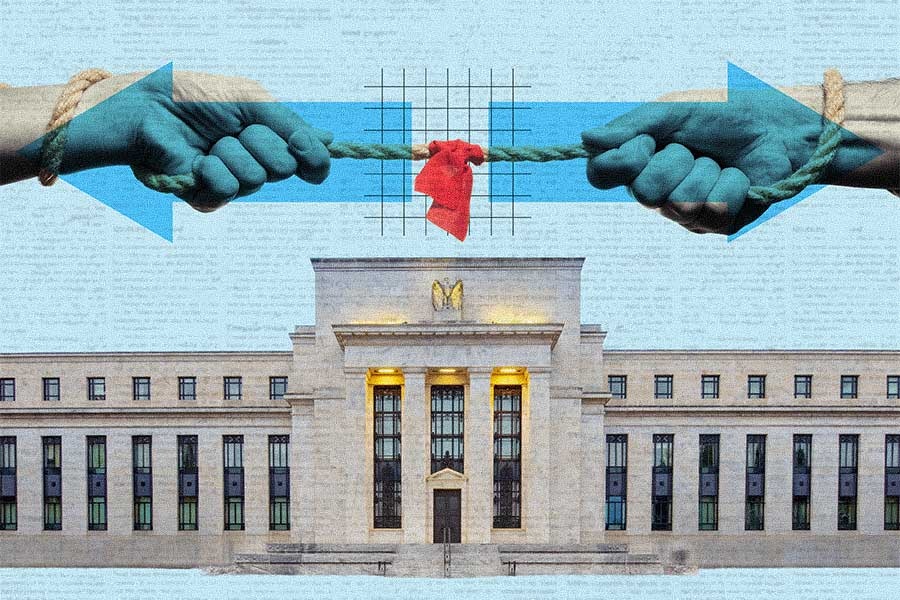
• The Fed's dual mandate is the U.S. central bank's responsibility to promote maximum employment and stable prices when setting monetary policy.
• Maximum employment doesn't mean zero unemployment; it refers to the strongest labor market that can be sustained without undermining price stability.
• The Fed defines price stability as low, steady inflation with a long-term target of 2%, as measured by the PCE price index.
• When inflation and employment goals conflict, Fed officials take a balanced approach that weighs how far each goal is from its target and how long it may take to get there.
• Investors can track the Fed's progress toward its dual mandate to better understand the central bank's decisions and potential shifts in interest rate policy.
The Federal Reserve has two primary goals when setting monetary policy: maximum employment and stable prices. Together, these are known as the Fed's dual mandate.
While these goals may seem straightforward, in practice, they're anything but. Neither goal is as simple to define as it might sound, and sometimes when officials pursue one goal, they inadvertently make it harder to achieve the other. Understanding how the Fed navigates this tension can help investors make sense of interest rate decisions and better understand factors that influence monetary policy.
Maximum employment
The Fed's maximum employment goal doesn't mean pushing the unemployment rate as close to 0% as possible. Some unemployment is inevitable. Even in a healthy labor market, people leave jobs, search for new ones, and move in or out of the workforce.
Instead, the Fed defines maximum employment as the highest level of employment that can be sustained over time while maintaining stable prices. However, there's no precise way to measure this level, and it changes over time as economic conditions evolve. As a result, the Fed doesn't have a specific target for the unemployment rate. It instead relies on Federal Open Market Committee (FOMC) officials' assessments, which are based on a broad range of labor market data.
Fed officials do have a useful, unofficial benchmark for maximum employment: the natural rate of unemployment. This is the baseline level of joblessness that occurs in a healthy economy. Economists generally put the natural rate of unemployment in the United States somewhere between 3.5% and 4.5%, though estimates vary and change over time.
Price stability
The Fed has a much more concrete definition of price stability. Since 2012, the central bank has formally targeted 2% inflation, as measured by the Personal Consumption Expenditures (PCE) price index. More broadly, the Fed defines price stability as inflation that is low and stable enough to ensure price swings aren't a major consideration in the spending, saving, and investment decisions of businesses and consumers.
The Fed targets 2% inflation rather than no inflation at all because a small amount of inflation provides a buffer against the threat of deflation and gives officials room to cut interest rates during economic downturns.
Importantly, 2% is a long-term target. The Fed doesn't expect inflation to remain at 2% consistently. This means temporary moves above or below this target don't always require an immediate policy response. Instead, the Fed simply seeks to return inflation to its target over time.
When goals clash
The Fed's two main goals are meant to work together. Low and stable inflation can help support a healthy labor market, while a balanced labor market can help keep inflation in check. However, economic conditions can also put the two sides of the Fed's dual mandate in conflict.
Imagine an economy with elevated inflation and rising unemployment—a combination sometimes known as stagflation. If the Fed raises rates to fight inflation, it risks weakening the economy and the labor market. But if it lowers rates to support hiring, it risks exacerbating already elevated inflation.
When the Fed's two goals conflict, officials tend to take what they call a "balanced approach." They essentially consider how far employment and inflation are from their targets and how long it will take them to return to acceptable levels to help determine which side of the dual mandate needs to be remedied first.
There's no specific formula for making this judgment, however, which can lead to disagreement among FOMC voting members. Some officials tend to be more hawkish, meaning they're generally more concerned about the threat of inflation, while others tend to be more dovish, meaning they're more concerned about risks to employment.
For investors, the inherent conflict in the Fed's dual mandate can make gauging the path of monetary policy challenging. But tracking how far the Fed is from each of its goals may provide some clues about how officials might respond moving forward.
Tracking the Fed's progress
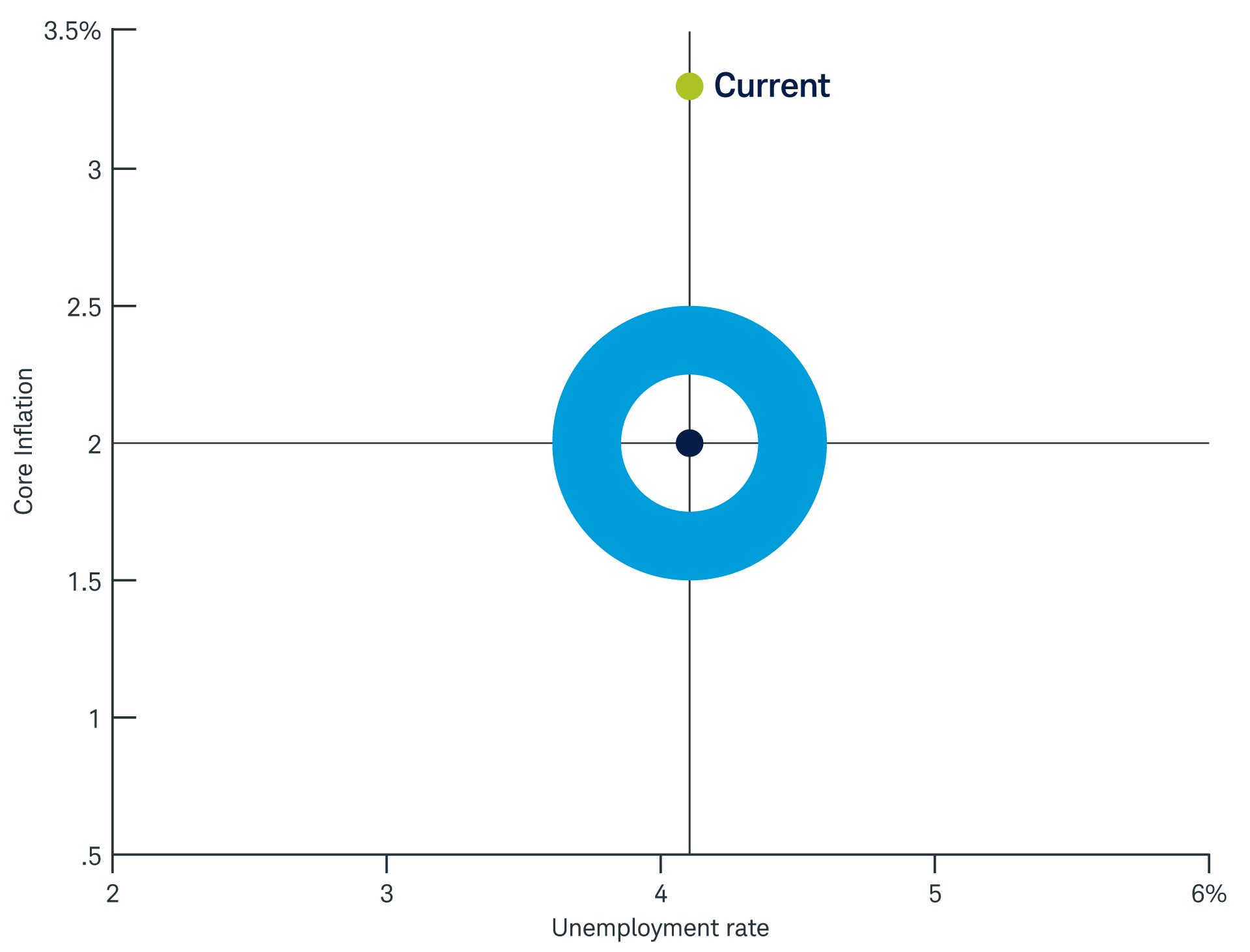
The Federal Reserve Bank of Chicago created a simple visual, called the bullseye chart, that shows how close the Fed is to achieving both sides of its dual mandate. The chart plots the unemployment rate against core PCE inflation, with a horizontal line at the Fed's 2% inflation target and a vertical line at FOMC participants' estimate of full employment. The spot where these two lines meet is the bullseye—where both monetary goals are met.
The lines also divide the chart into four quadrants. Plotting the current core PCE inflation rate and the unemployment rate on the bullseye chart can show investors how far the Fed is from each goal and indicate whether the two goals are currently in conflict.
|
Quadrant |
Unemployment |
Core inflation |
Goals clash |
|---|---|---|---|
|
Northeast |
Above target |
Above target |
Yes |
|
Northwest |
Below target |
Above target |
No |
|
Southeast |
Above target |
Below target |
No |
|
Southwest |
Below target |
Below target |
Yes |
In general, the farther the current core PCE and unemployment dot moves from the bullseye, the more pressure the Fed may face to adjust its policy. When that dot lands in a quadrant that shows the two sides of the dual mandate aren't in conflict, the potential policy response from the Fed is often more straightforward. For example, when unemployment is above target and core inflation is below target, the Fed may be more inclined to lower rates. However, when the dot lands in a quadrant that shows the two sides of the Fed's dual mandate are in conflict, the balancing act becomes more complex, making the path of rates less predictable.
Note: The bullseye chart is a simplified analytical tool that may help investors understand how current economic conditions relate to the Fed's dual mandate. However, it does not incorporate all factors considered by policymakers and should not be viewed as a predictor of future Federal Reserve policy decisions.
The Fed's Bullseye Chart
Source: Federal Reserve Bank of Chicago, Bureau of Labor Statistics
For illustrative purposes only. The "current" dot reflects core inflation and unemployment rates as of September 15, 2026.
The forgotten mandate
In 1977, Congress amended the Federal Reserve Act, effectively creating the dual mandate for the Fed. However, in that amendment, policymakers also added a less-talked-about goal for the central bank: moderate long-term interest rates. Specifically, the law directs the Fed to "promote effectively the goals of maximum employment, stable prices, and moderate long-term interest rates."
Despite this language, moderate long-term interest rates generally aren't treated as a third mandate for the Fed. Former Fed Chair Jerome Powell addressed this issue directly in 2025, noting that officials view moderate long-term interest rates as a natural outcome of achieving price stability and maximum employment.
This doesn't necessarily make the provision irrelevant, however. Long-term rates can rise due to factors outside the Fed's control, like excessive government borrowing, rising inflation expectations, or strong economic growth. As a result, sustained periods of elevated long-term rates could bring greater attention to this under-the-radar part of the Fed's mandate.
Bottom line: Follow the mandate for policy clues
The Fed's dual mandate is the foundation for every decision made by the central bank. For investors, tracking the economy's progress toward both sides of the mandate—and recognizing when those goals conflict—can help explain Fed decisions and provide insight into the factors that may influence interest rate policy.