Why a Market High May Not Be a Bad Time to Buy

When the stock market hits an all-time high—as it has multiple times this year—investors often interpret it as a sign of an imminent downturn. This can lead them to reduce their current market exposure or hesitate to invest new capital.
"Unfortunately, neither is a logical investment decision," says Chris Ferrarone, head of equity research and strategy at the Schwab Center for Financial Research. "There's nothing about a new market high that warrants concern in and of itself."
The facts back this up. Chris and his team analyzed market data that spanned more than 25,000 trading days from January 1928 to May 2026, during which the S&P 500® Index hit a record high 1,400 times. They looked at six-month, one-year, three-year, and five-year future returns for each of those days to determine if and when the market underperformed after a new record high.
"Future returns after all-time highs were almost identical to average future returns for all trading days," Chris says. "That's because new market highs typically coincide with periods of economic expansion and rising earnings."
A closer look
All-time highs can feel like a signal to step back, but history tells a different story.
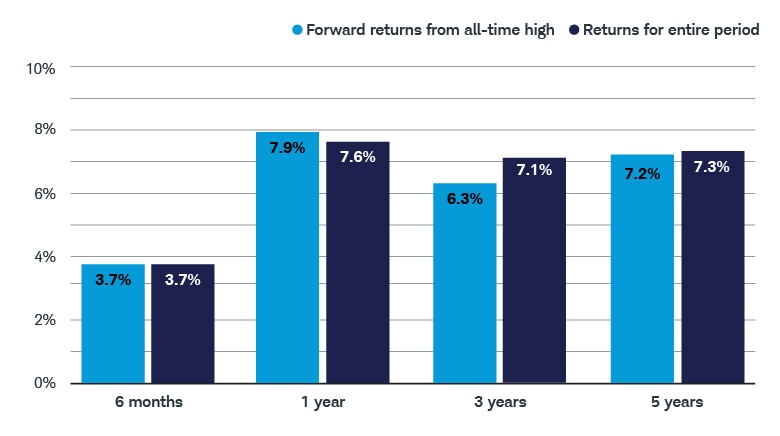
Source: Schwab Center for Financial Research with data from Robert Shiller and Standard & Poor's.
Data from 01/03/1928 through 05/11/2026. Periods greater than one year are annualized. For illustrative purposes only. Individual situations will vary. Not intended to be reflective of results you can expect to achieve. Illustration should not be used as a basis for any investment decision. Performance data quoted represents past performance and is no guarantee of future results. Returns are based on total return, which assumes reinvestment of dividends and distributions. Current performance may be lower or higher than performance data quoted. Returns do not reflect the impact of taxes.
While past performance does not guarantee future results, the analysis shows that new highs often have been followed by even higher highs, suggesting it may be potentially costly to get out of the market when stocks are doing particularly well.
Plus, new highs may be a good opportunity to examine and manage risk. Investors should consider rebalancing their portfolios—especially if growth has thrown off their intended asset allocation. Instead of focusing solely on price, they might also pay attention to a stock's valuation, the prevailing macroeconomic environment, the relative strength of corporate profits, and even investor sentiment.
Be that as it may, Chris notes that while each investor's situation is unique, often "the most effective general strategy remains the most disciplined one: stay invested, tune out the daily noise of record highs, and let a well-diversified portfolio do its job."
Discover more from Onward

Keep reading the latest issue online or view the print edition.