Why Stocks Sometimes Ignore Good (or Bad) News
Key takeaways
- Stock prices are shaped by more than just earnings results and headlines. Investors' expectations about what stocks may earn in the future often drive near-term price movement.
- Stocks can move against positive or negative headlines if the news is already anticipated and effectively "priced in."
- Companies' forward-looking outlook in guidance and earnings call commentary often matters more than past earnings results.
- Short-term price movements can also be impacted by mechanics such as index changes, institutional positioning, and tax-related portfolio moves.
- In the near-term, stocks can be driven by investors' emotions and hype, but in the long run, prices tend to reflect companies' fundamental, intrinsic values.
- Stock prices are shaped by more than just earnings results and headlines. Investors' expectations about what stocks may earn in the future often drive near-term price movement.
- Stocks can move against positive or negative headlines if the news is already anticipated and effectively "priced in."
- Companies' forward-looking outlook in guidance and earnings call commentary often matters more than past earnings results.
- Short-term price movements can also be impacted by mechanics such as index changes, institutional positioning, and tax-related portfolio moves.
- In the near-term, stocks can be driven by investors' emotions and hype, but in the long run, prices tend to reflect companies' fundamental, intrinsic values.
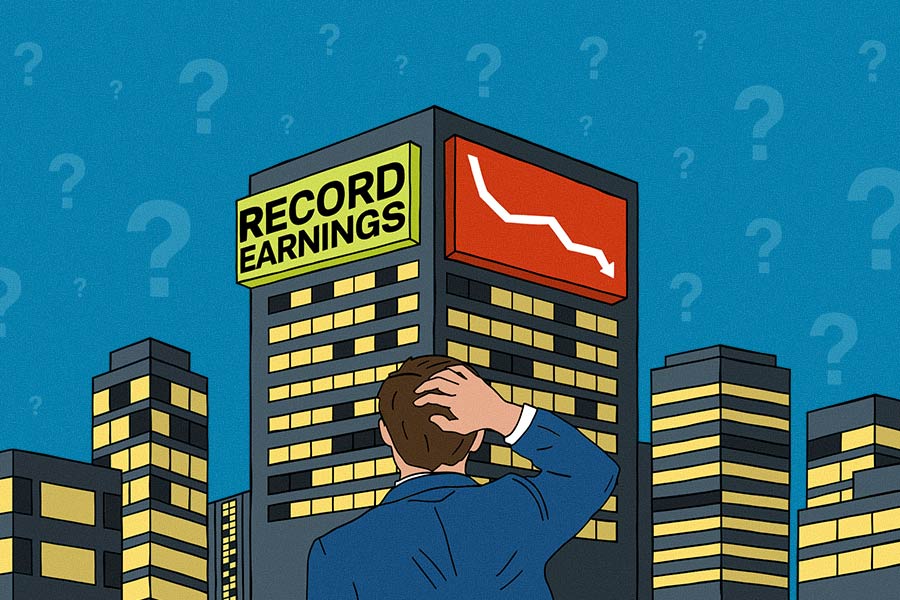
Stocks sometimes move in counterintuitive ways. A company can report record earnings and watch its stock plummet, while another reports weak results and sees its shares surge.
These moves can seem irrational and confuse investors, but stock prices are driven by more than just headlines or quarterly numbers. Markets are constantly looking ahead, meaning investor expectations, corporate guidance, interest rates, and economic data can matter just as much—or more—than any single headline.
Understanding what drives stock prices and why stocks sometimes appear to ignore good (or bad) news is critical for investors looking to build wealth and manage risk over the long term.
Expectations vs. reality
The first thing to understand is that, in theory, stock prices reflect the present value of future expected cash flows. That's a fancy, academic way to say stock prices are largely shaped—in the near term—by what investors expect companies to earn in the future.
As Benjamin Graham, an American investor known as the "father of value investing," once put it: "In the short run, the market is a voting machine, but in the long run, it's a weighing machine."
Investors, like voters, don't always vote based on the latest headlines, and they can become overly optimistic or pessimistic. When a stock moves against a positive or negative headline, it doesn't mean the news didn't matter. More often, something else had an even greater influence on investors' expectations. Geopolitics, Federal Reserve policy, economic data, market sentiment, and more can all shape expectations dramatically.
The recurring, often emotional behaviors of investors as they attempt to anticipate future earnings have led market watchers to coin a few platitudes that help explain seemingly illogical stock movements. These market clichés serve as shorthand for investor psychology, representing how optimism or fear can drive stock prices away from, or toward, fundamental valuations.
Take the phrase "priced in." Sometimes, even when a company tops Wall Street's forecasts and provides strong forward guidance in an earnings report, its shares can sink because investors' lofty expectations were already reflected in the stock's price. If investors expect a standout earnings report, a company often needs to deliver that—and more—for its stock to rise.
On February 25, 2026, for example, Nvidia (NVDA) reported record fourth-quarter profits and revenues, but the shares dropped roughly 9% over the following two days. The surging semiconductor giant simply didn't meet investors' high expectations amid the AI boom. Record revenues and profits were already effectively "priced in," meaning the company had to produce something special for its stock to respond positively to the earnings report. As JPMorgan analysts put it at the time: "Investors were left wanting more."
Then there's the classic "buy the rumor, sell the news" cliché. Sometimes investors will buy a stock based on speculation that positive news is coming and then sell when the news is officially released. The goal is to anticipate, or front-run, an event that could cause a stock's price to rise. This tactic can lead positive or negative news to be "priced in" before it's officially announced. As a result, stocks will sometimes fall on what appears to be good news as investors "sell the news."
These cliches illustrate that shifts in investors' expectations are what really drive stock prices—at least in the near term. This makes constantly gauging what's driving these expectations critical, particularly for short-term traders.
What drives investors' expectations?
Forward guidance and executive commentary on earnings calls are two of the most obvious factors that can cause stocks to trade in counterintuitive ways.
A company can report standout earnings, but if guidance disappoints, investors may anticipate weaker future earnings, leading the stock to fall. Conversely, a company can report weak earnings but offer upbeat guidance and bullish commentary on an earnings call, causing its stock to rise.
Headline numbers don't tell the whole story. And they can sometimes confuse investors, making it seem like a stock is ignoring good or bad news after an earnings report, when, in reality, the market is often simply more focused on the path ahead.
Fed policy and the state of the economy can also lead stocks to seemingly ignore the news. A red-hot inflation report or weak gross domestic product (GDP) data can ring alarm bells for investors, pushing them out of a stock even after positive earnings results.
In 2022, for example, Apple (AAPL) reported record first-quarter revenue that exceeded analysts' consensus estimates across the board. Over the following two weeks, however, the stock dropped more than 10%. Investors weren't disappointed by Apple's earnings; it was rising inflation—and the threat of higher interest rates—that weighed on the stock. At the time, consumer prices were surging ahead at an 8% annual clip. That was enough to convince many investors that it was not a good time to invest in tech stocks that typically benefit from lower rates.
Ultimately, it all comes back to investors' expectations. A strong earnings report, regulatory approval for a new drug, or analyst upgrade can often be overshadowed by other factors, making it appear as if the market is ignoring recent news.
Flows and positioning
Flows in and out of markets can also lead stocks to trade in unusual ways in the near term by fueling temporary supply-and-demand imbalances that move stock prices.
For example, when stocks are added to or removed from major indexes, institutional investors and index funds are typically forced to either buy or sell, respectively, which can create temporary, artificial price surges or drops.
Retail flows caused by tax-season selling or tax-loss harvesting can have a similar effect. In April, investors often sell stocks to raise cash for tax payments, which can put downward pressure on the market. This may cause a company's stock price to fall even on good news that would typically drive its price higher.
In the latter part of each year, some investors also attempt to offset their capital gains taxes by selling underperforming stocks. This tax-loss harvesting can weigh on the market initially and then lead to a rebound in January, sometimes called the "January Effect," when investors repurchase the shares they sold the prior year to reduce taxes. These flows in and out of stocks can sometimes cause stocks to trade in seemingly paradoxical ways.
Finally, forced or pre-planned institutional selling can create more supply for a stock than there is demand to meet it, occasionally leading shares to fall even on positive headlines. If a large hedge fund faces a margin call on a concentrated position, for example, selling pressure in that stock can have a serious impact on its share price in the near term, leading it to largely ignore other news.
Bottom line: Focus on the weighing machine, not the voting machine
While a stock rising on bad news or falling on good news may seem illogical, there's almost always a reason behind the move. Sometimes, it's simply institutional flows temporarily driving stock prices higher or lower, but most of the time, the moves can be attributed to investors' expectations. Whether it's guidance, economic data, or earnings call commentary, there's always a range of underlying factors influencing these expectations.
At the end of the day, near-term stock movements can be unpredictable—the market's "voters" are easily swayed. However, eventually, the "weighing machine" typically does its job, leading stocks to largely reflect their fundamental, intrinsic value. That's why many, if not most, long-term investors choose to stay the course and focus on fundamentals and investing principles, even when stocks seem to have minds of their own.