Fed Brings a Demand Tool to a Supply Fight
Higher U.S. interest rates won't reopen the Strait of Hormuz, repair supply chains, or build more homes. Those are supply problems. Interest rates target demand, seeking to cool it off.
This mismatch explains why the first two questions Federal Reserve Chair Kevin Warsh faced from reporters after the Fed voted in September to hike interest rates for the first time in three years were basically the same question: How will higher rates lower inflation that's driven largely by supply problems?
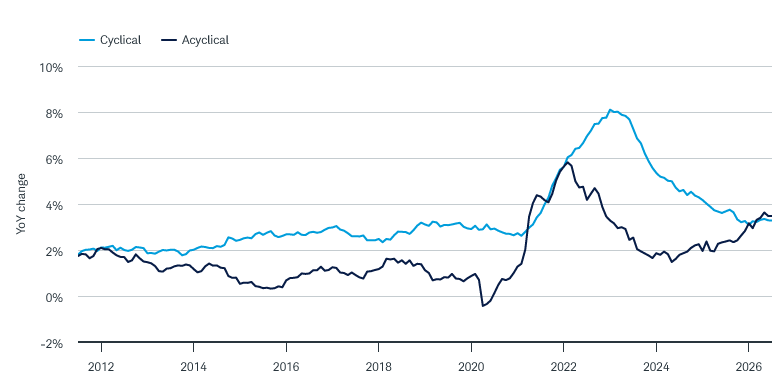
Data from the Federal Reserve Bank of San Francisco illustrates the challenge. It divides the Personal Consumption Expenditures (PCE) core price index, which excludes energy and food prices, into two categories: cyclical and acyclical inflation. Cyclical inflation is driven by economic strength and demand and therefore is more responsive to interest rates. The other is acyclical inflation, which doesn't track economic cycles, often results from supply problems or industry-specific costs, and is less responsive to rates.
Though cyclical inflation has leveled off in recent months, it had been steadily cooling since 2023. Meanwhile, acyclical inflation has been trending higher since early 2024 and stood at 3.5% in July, three times the 2011–2019 average and more than halfway to the 2022 peak hit during the Covid-era supply disruptions.
Cyclical and acyclical core PCE inflation
Source: Federal Reserve Bank of San Francisco
For illustrative purposes only.
The data also illustrates how differently cyclical and acyclical inflation respond to interest rates.
Following the Covid outbreak, acyclical inflation began to surge much earlier than cyclical inflation. It peaked in February 2022, before the Fed's first rate hike of that cycle, and fell below 2% relatively quickly as supply chain problems were resolved. Meanwhile, it took another year for cyclical inflation to peak and even longer for it to decline. It still hasn't fallen as low as 2%.
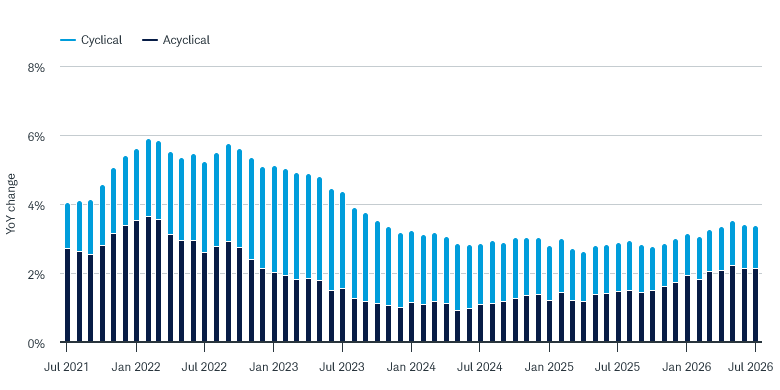
Additional data from the San Francisco Fed shows that the recent rebound in PCE core inflation has been driven primarily by acyclical inflation. Acyclical inflation accounted for nearly two-thirds of PCE core inflation in July 2026—2.13 percentage points of the 3.39% reading. (Again, this doesn't include energy prices.) Meanwhile, though cyclical inflation has ticked higher in recent months, as of July it was lower than it was a year earlier.
Cyclical and acyclical contributions to core PCE inflation
Source: Federal Reserve Bank of San Francisco
For illustrative purposes only.
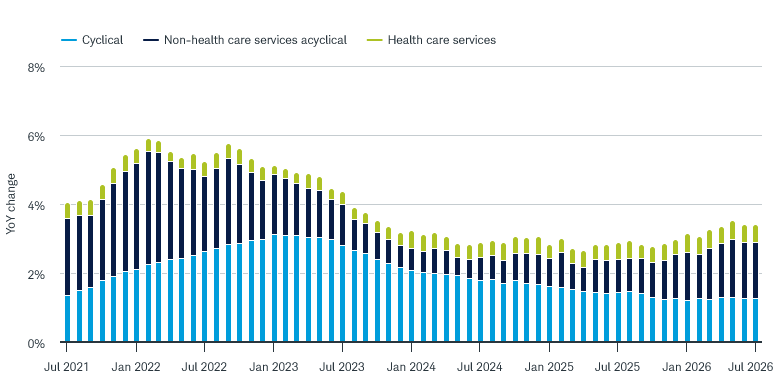
Health care services, which aren't affected much by the state of the economy, have consistently been a significant source of acyclical inflation. But health care service costs don't explain the recent surge in acyclical inflation. They accounted for only 0.53 percentage points of the July 2026 core PCE reading, compared to 1.61 points for the rest of acyclical inflation.
In fact, health care services' share of acyclical inflation has fallen steadily over the past few years. In January 2024, health care services accounted for 44% of all acyclical inflation. That had fallen to 22% by July 2026.
Health care services' contribution to core PCE inflation
Source: Federal Reserve Bank of San Francisco
For illustrative purposes only.
During his press conference following the September rate hike, Warsh acknowledged the premise of reporters' questions about rate hikes and supply problems: "We cannot affect any individual price, whether it be oil prices, whether it be foodstuffs at the grocery store. But what we can do and will do is ensure that any changes in relative prices don't broaden out."
In other words, by raising rates and tamping demand, the Fed seeks to prevent supply-driven inflation from spreading at a time when the economy is strengthening and spending remains resilient. The first chart at the top illustrates the risk of letting acyclical inflation go unaddressed, although multiple factors drove the 2021–23 spike in cyclical inflation.
The risk is always that higher rates end up sapping too much demand, weighing on the economy and the job market. This scenario would disproportionately hurt the "least well-off," whom Warsh said "have the most to gain from a durable expansion, a solid labor market, and stable prices."