Supreme Court Tariff Ruling Shifts Focus to Plan B
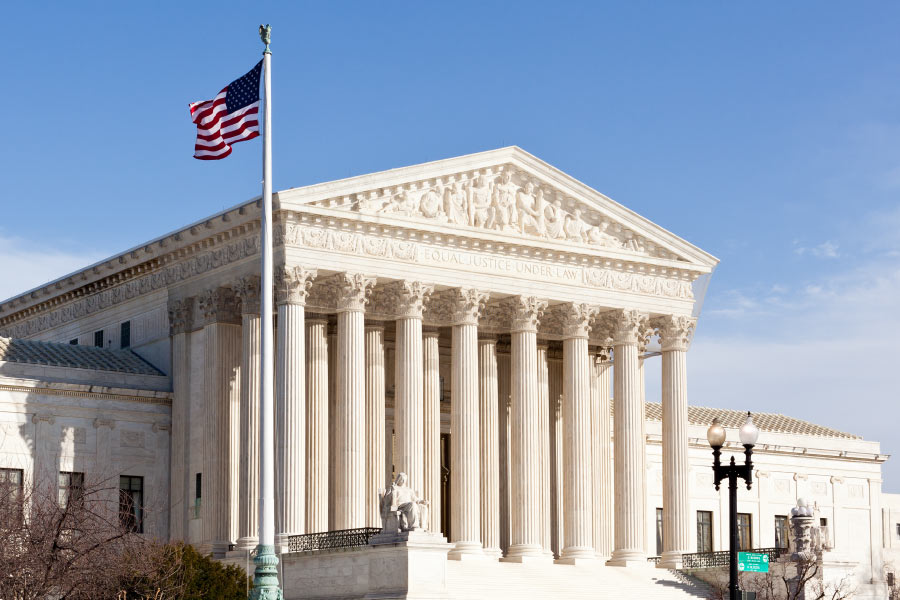
The U.S. Supreme Court struck down a core pillar of President Trump's trade agenda on Friday, ruling 6-3 that his broad tariffs imposed under the International Emergency Economic Powers Act (IEEPA) were unconstitutional. Chief Justice John Roberts delivered the majority opinion of the court, which concluded that Trump's policies "would represent a transformative expansion of the President's authority over tariff policy." Justices Clarence Thomas, Samuel Alito, and Brett Kavanaugh dissented.
"This is a big blow to the president's signature economic policy, no question. But there are other mechanisms available to the president to impose tariffs. The administration has said it has a 'Plan B,' and I expect it will start implementing that right away," said Michael Townsend, managing director, legislative and regulatory affairs, at Schwab.
Townsend noted that there is an emergency provision that allows the imposition of up to 15% tariffs for 150 days. "If nothing else, that will buy the administration some time," he said. President Trump quickly took advantage of this provision on Friday, saying he would sign an executive order imposing 10% global tariffs after the Supreme Court's ruling, Bloomberg reported.
The Trump administration could also impose tariffs through the traditional process. That would involve a study by either the Commerce Department or the US Trade Representative's office, a report, and a public review. This is how sector- and product-specific tariffs have historically been imposed, including those currently imposed on steel, aluminum, copper, automobiles, and furniture. "Those tariffs are not impacted by today's ruling. So I expect the administration will use those processes going forward. It's time consuming, but it's possible," Townsend said.
That said, the Court's ruling does tie the president's hands, to some extent, after a year in which he generally implemented tariffs without input from Congress or other agencies.
"There really isn't anything that has the sweeping, broad reach that the president used to impose those reciprocal tariffs, but tariffs are definitely not going away," Townsend said.
The ruling did not say whether tariffs already paid at higher rates would need to be refunded. The Penn-Wharton Budget Model recently estimated that the federal government could owe more than $175 billion in refunds to importers if Trump's tariffs were declared unconstitutional. "It's a huge unresolved question," said Townsend. "Ultimately, it will be up to lower courts. The process could take a long time—perhaps years—to sort out. In his dissent today, Justice Brett Kavanaugh said that resolving the refunds issue will be 'a mess,' and I think he's pretty much hit the nail on the head with that assessment."
How are the markets reacting?
Markets initially swung higher after the ruling but were also grappling with bearish inflation and economic growth data out earlier in the day. By midday, major indexes were flat to slightly higher, led by the tech and communication services sides. These sectors are traditionally among the S&P 500® sectors most exposed to international trade, and Apple (AAPL), Taiwan Semiconductor Manufacturing (TSM), Amazon (AMZN), and Micron (MU) were among the leading stocks in midday trading. The S&P 500 Index rose 0.4% as of 1 p.m. ET and approached recent highs, while the Nasdaq Composite, which is more exposed to tech, rose 0.67%.
Many consumer firms—including retailers and apparel companies such as Nike (NKE) and Walmart (WMT)—manufacture or import their products in Asia and sell them in the U.S and have suffered from margin pressure from tariffs.
"Harvard and U Chicago studies showed that more than 90% of tariffs' burden has fallen on American importers, not foreign producers," said Liz Ann Sonders, chief investment strategist at the Schwab Center for Financial Research. "As such, this could provide a tailwind to consumer confidence and retailers' outlooks."
After an initial move higher on the news, however, some of these names reversed lower, perhaps indicating that investors had priced in the news and were taking profits. That might also explain the dip in shares of some large industrial names that suffered from tariffs, including Deere (DE) and Caterpillar (CAT). Both of those stocks have been on a roll so far this year, possibly pricing in the news.
International stocks initially jumped on the ruling, too, possibly on ideas that lower U.S. tariffs might mean better export opportunities, especially for automakers and commodity producers. It's unclear what impact the ruling might have on any deals the U.S. negotiated with foreign countries under auspices of the tariffs, however. Earlier this week, President Trump announced Japan making tens of billions of dollars of investments in several U.S.-based projects.
Treasury yields rose slightly on the news, though their move could also reflect a hotter-than-expected Personal Consumption Expenditures (PCE) price index report earlier today. The tariffs had brought hundreds of billions of dollars to the U.S. government and helped ease deficit concerns. Now it's unclear if Washington can keep that money, raising new worries about government debt. Treasuries—which move opposite of yields—tend to get hurt by rising debt levels that suggest possible higher inflation and pressure on the dollar.
However, there are some clear economic and market benefits from the Supreme Court's decision.
"The most immediate economic upside is less instability and more clarity given that shifting tariffs rules and announcements had been complicating supply chain decisions, pricing strategies and capex plans," said Sonders.